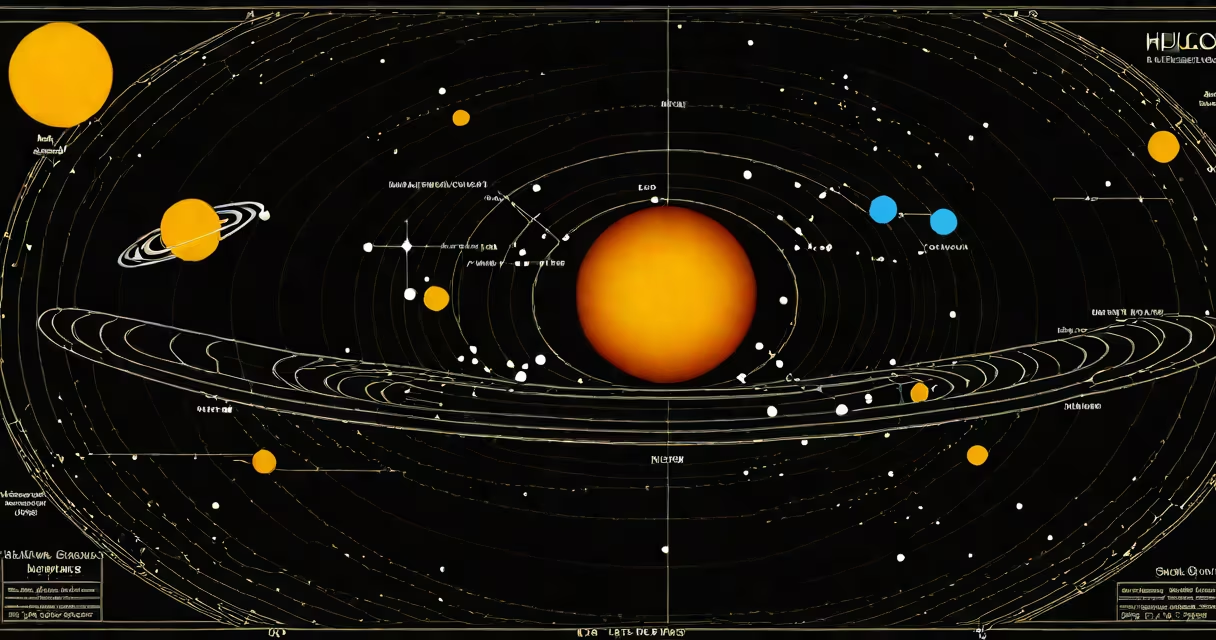
The heliocentric model of the solar system is a cosmological structure that positions the Sun at the center, with Earth and other planets orbiting it. This model contrasts with the ancient geocentric view, which placed Earth at the center. It emerged from mathematical observations and challenged long-held religious and philosophical beliefs about humanity's place in the cosmos.
Nicolaus Copernicus first proposed the heliocentric model in 1543 in his work De revolutionibus orbium coelestium. He argued that planetary motions could be explained more simply if the Sun, not Earth, was the central point. His calculations showed that the apparent retrograde motion of planets-where they seem to reverse direction in the sky-could be explained by Earth's own movement around the Sun.
Before Copernicus, Ptolemy's geocentric model dominated Western thought for over 1,400 years. That model used complex systems of epicycles-small circles within larger ones-to explain planetary paths. The heliocentric model eliminated the need for most epicycles, reducing complexity. While Copernicus still assumed circular orbits, later work by Johannes Kepler refined the model using elliptical orbits based on Tycho Brahe's precise observational data.
The heliocentric model describes planetary motion using orbital mechanics. Each planet moves along an elliptical path, with the Sun at one focus. Planets closer to the Sun move faster due to stronger gravitational pull, following Kepler's laws of planetary motion. Mercury completes an orbit in 88 days; Neptune takes 165 Earth years.
Earth's orbit is nearly circular, with an average distance of 149.6 million kilometers from the Sun-this distance defines one astronomical unit (AU). The model accounts for seasonal changes through axial tilt, not Earth's changing distance from the Sun. For example, Earth is closest to the Sun (perihelion) in early January, yet the Northern Hemisphere experiences winter then-proof that seasons stem from tilt, not proximity.
Modern space missions rely on the heliocentric model for trajectory planning. NASA's Mars rovers, such as Perseverance, were launched during favorable launch windows when Earth and Mars aligned optimally. These alignments occur roughly every 26 months, calculated using precise heliocentric orbital data.
The heliocentric model evolved through three key phases:
| Phase | Key Figure | Orbital Shape | Major Contribution |
|---|---|---|---|
| Initial proposal | Nicolaus Copernicus | Circular | Placed Sun at center; simplified planetary motion mathematically |
| Refinement | Johannes Kepler | Elliptical | Discovered planets follow ellipses, not circles; introduced laws of motion |
| Scientific validation | Galileo Galilei, Isaac Newton | Elliptical | Galileo observed Jupiter's moons and Venus's phases; Newton explained gravity as the force behind orbits |
Galileo's 1610 telescope observations provided direct evidence against geocentrism. He saw four moons orbiting Jupiter-proving not everything revolved around Earth. He also observed Venus go through phases like the Moon, which only makes sense if Venus orbits the Sun.
Newton's 1687 Principia Mathematica formalized the model with universal gravitation. He showed that the same force pulling an apple to the ground also keeps planets in orbit. His equations allow accurate prediction of planetary positions centuries in advance.
Many assume the heliocentric model was widely accepted soon after Copernicus. It wasn't. The Catholic Church condemned his work in 1616 and banned De revolutionibus until 1835. Galileo was forced to recant in 1633 under house arrest. The model took over 200 years to gain broad scientific acceptance.
Another misconception is that Earth's orbit is perfectly circular. It is not. Earth's orbit varies slightly due to gravitational interactions with other planets, especially Jupiter. These perturbations cause small changes in orbital eccentricity over time, cycling every 100,000 years-a factor in climate cycles known as Milankovitch cycles.
A lesser-known fact: the Sun is not truly stationary. Both the Sun and planets orbit the center of mass of the entire solar system-the barycenter. This point lies near the Sun's surface but shifts depending on planetary alignment. When Jupiter and Saturn align on the same side, the barycenter can lie just outside the Sun's radius.
In 2012, NASA used the heliocentric model to calculate the optimal launch window for the Juno spacecraft to reach Jupiter. Engineers determined that launching in August 2011 would allow Juno to perform a gravity assist flyby of Earth in October 2013. This maneuver increased Juno's speed enough to reach Jupiter in 2016.
The calculation relied on precise orbital parameters derived from the heliocentric model. Without it, the mission would have required more fuel and failed. Juno's successful orbit insertion in July 2016 confirmed the model's predictive power.
I once watched a live simulation of planetary orbits at the Griffith Observatory in Los Angeles. When the screen switched from geocentric to heliocentric view, the chaotic looping patterns of Mars disappeared. The planets moved smoothly in their correct paths. That moment solidified my understanding: the heliocentric model isn't just theory-it's how we actually go through space.
The heliocentric model is foundational to modern astronomy. It enables satellite deployment, interplanetary navigation, and exoplanet detection. When astronomers discover new planets outside our solar system, they use the same principles to determine orbital stability and habitable zones.
For example, the TRAPPIST-1 system contains seven Earth-sized planets orbiting a red dwarf star. Scientists modeled their orbits using heliocentric-style dynamics, calculating that three planets lie in the star's habitable zone-where liquid water could exist. This analysis relies entirely on the same physics that Copernicus began to describe.
Understanding the heliocentric model isn't just academic. It shapes how we explore space, interpret celestial events, and even define our place in the universe. It's not just a historical shift-it's the structure that allows us to send probes to distant worlds.