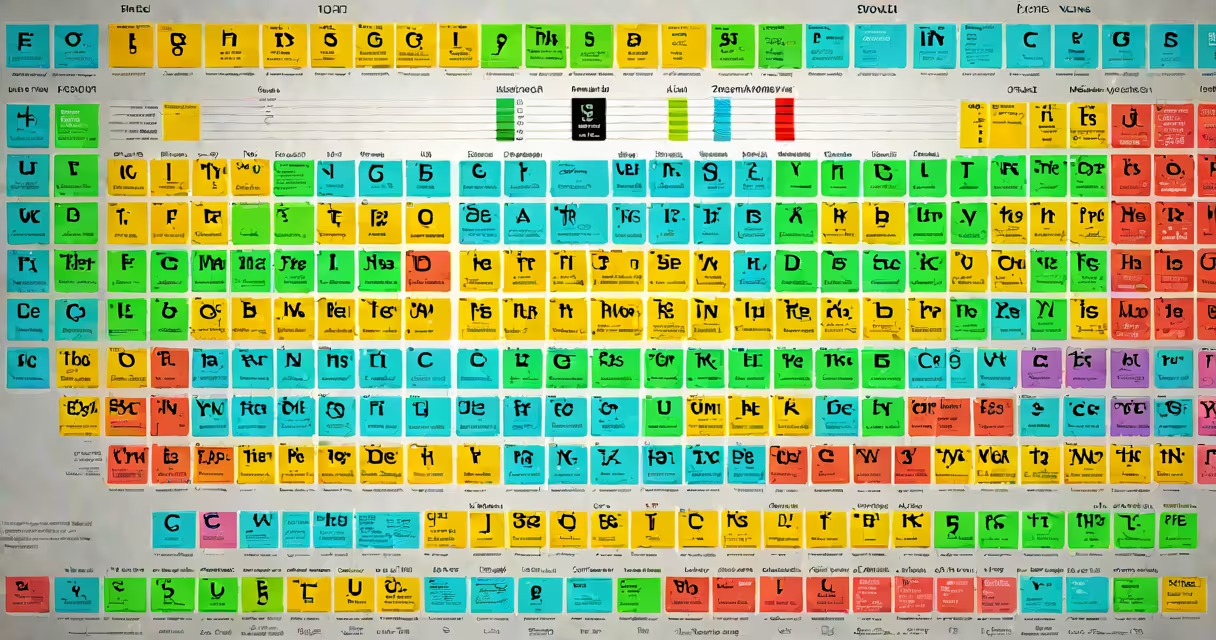
The list of all elements contains 118 confirmed chemical elements, each uniquely identified by its atomic number-the number of protons in its nucleus. These elements form the foundation of all known matter and are organized in the periodic table based on recurring chemical and physical properties.
Each element is a pure substance composed of atoms with the same number of protons. For example, hydrogen has atomic number 1, helium 2, and uranium 92. The list includes naturally occurring elements (up to uranium, atomic number 92) and synthetic elements created in laboratories beyond uranium, such as oganesson (element 118).
Elements are defined by their atomic structure, not by abundance or practical use. The list is finite and complete through element 118, as confirmed by the International Union of Pure and Applied Chemistry (IUPAC). No new elements have been officially recognized since 2016, when nihonium, moscovium, tennessine, and oganesson were added.
The periodic table arranges elements in rows (periods) and columns (groups) based on electron configuration and recurring trends. Elements in the same group share similar chemical behavior-like fluorine and chlorine in Group 17, both highly reactive halogens.
Elements are categorized into metals, metalloids, and nonmetals. Metals dominate the left side and center of the table-iron, copper, gold-and exhibit conductivity, malleability, and luster. Nonmetals appear on the upper right-oxygen, nitrogen, sulfur-and tend to gain electrons in reactions. Metalloids like silicon and arsenic lie along the diagonal dividing line and display mixed properties.
For example, carbon (atomic number 6) appears in Group 14. It forms the basis of organic chemistry and exists in multiple allotropes: graphite, diamond, and graphene. Its versatility arises from its ability to form four covalent bonds-a property shared by other Group 14 elements like silicon and lead.
Elements fall into distinct classes based on physical and chemical traits. The following table outlines major categories and key examples:
| Category | Examples | Key Traits |
|---|---|---|
| Alkali metals | Lithium (3), sodium (11), potassium (19) | Soft, highly reactive with water, form +1 ions |
| Alkaline earth metals | Magnesium (12), calcium (20), barium (56) | Less reactive than alkali metals, form +2 ions |
| Halogens | Fluorine (9), chlorine (17), iodine (53) | Highly reactive nonmetals, form -1 ions |
| Noble gases | Helium (2), neon (10), argon (18) | Colorless, odorless, chemically inert under standard conditions |
| Transition metals | Iron (26), nickel (28), copper (29) | Good conductors, variable oxidation states, catalytic activity |
Some elements exist in multiple isotopic forms-atoms with the same number of protons but different neutrons. Carbon-12 and carbon-14 are isotopes of carbon. While carbon-12 is stable, carbon-14 decays over time and is used in radiocarbon dating. This variation does not create new elements-only new nuclides.
The list of all elements underpins chemistry, materials science, geology, and environmental research. It enables accurate prediction of compound formation, reaction outcomes, and material behavior. For example, knowing that lithium is a light metal with high electrochemical potential led to its use in rechargeable batteries.
In medicine, iodine (53) is essential for thyroid function. Its deficiency causes goiter, and supplementation prevents endemic cases. The periodic table helped identify this link through elemental trends. Similarly, titanium (22) is used in implants due to its strength-to-weight ratio and biocompatibility-properties derived from its position in the d-block.
Industrial applications rely on precise element identification. Silicon (14) is critical in semiconductors. Its crystal structure allows controlled electron flow, enabling microchips. Without the list of all elements, identifying suitable materials for electronics would require trial and error across millions of compounds.
Many assume that all elements occur naturally. This is false. Elements 93 to 118 are synthetic and do not exist in nature in measurable quantities. Plutonium (94), for instance, was first synthesized in 1940. It decays rapidly and has no stable isotopes. Despite this, it powers nuclear reactors and weapons.
Another misconception is that elements can be transformed into one another through chemical processes. Chemical reactions rearrange atoms but do not alter atomic nuclei. Changing one element into another requires nuclear reactions-fusion, fission, or radioactive decay. These processes occur in stars, particle accelerators, or nuclear reactors-not in test tubes.
A lesser-known fact: the periodic table's layout reflects quantum mechanics. The arrangement of periods corresponds to electron shell filling. Period 1 holds 2 elements (H, He), period 2 holds 8 (Li to Ne), period 3 holds 8, and so on. This pattern aligns with the Aufbau principle and the Pauli exclusion principle-foundations of atomic theory.
Aluminum (atomic number 13) illustrates how the list of all elements informs design and engineering. Aluminum is lightweight, corrosion-resistant, and conducts electricity well. These traits stem from its electron configuration: [Ne] 3s² 3p¹.
When exposed to air, aluminum forms a thin oxide layer (Al₂O₃) that protects the underlying metal. This passive film makes it ideal for food packaging, aircraft bodies, and window frames. Over 60 million metric tons of aluminum are produced annually-most from bauxite ore via the Hall-Héroult process.
Without understanding aluminum's place in the periodic table, engineers couldn't predict its reactivity or alloy behavior. Adding copper (29) improves strength; adding magnesium (12) enhances weldability. These choices depend on knowing how elements interact-information derived from the full list.
I once built a simple electrolysis setup using saltwater and aluminum foil to demonstrate hydrogen production. The experiment failed because the aluminum surface oxidized instantly, blocking current flow. Only after cleaning the foil with vinegar did the reaction proceed. This taught me that elemental behavior isn't always predictable from appearance-surface chemistry matters as much as atomic number.