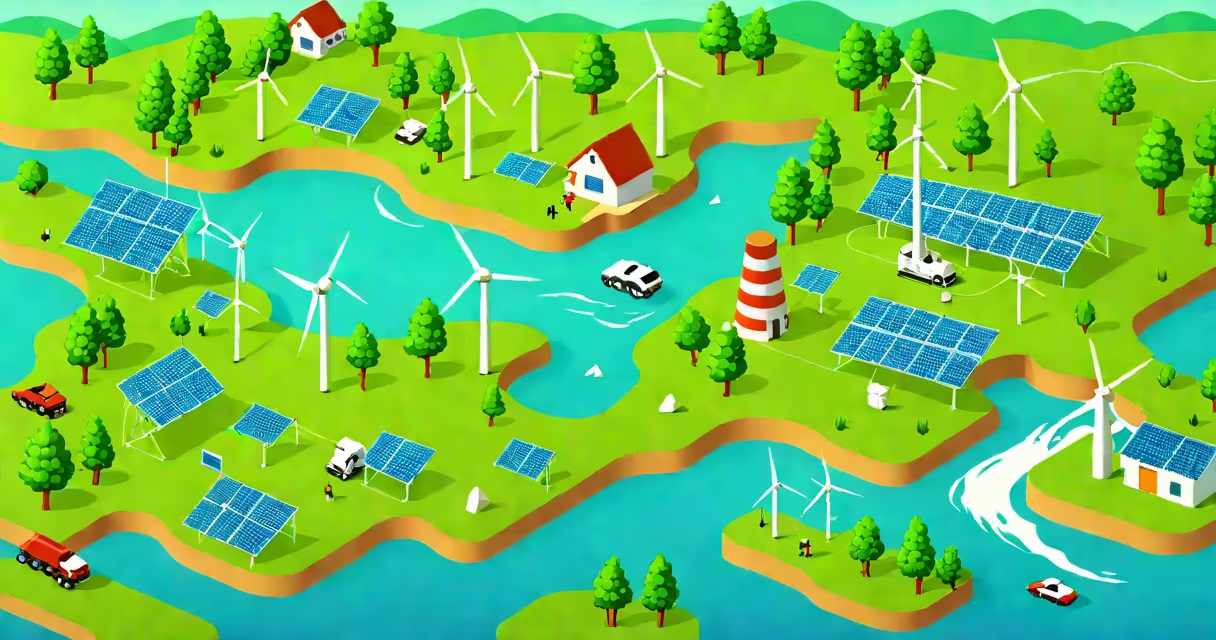
A list of renewable resources includes energy sources that naturally replenish within human timescales, such as sunlight, wind, flowing water, geothermal heat, organic matter, and tidal movements. These resources are sustainable and emit little to no greenhouse gases during energy generation.
Renewable resources differ from fossil fuels because they are not finite. While coal and oil take millions of years to form, renewable sources regenerate daily or seasonally. The United States Energy Information Administration (EIA) defines renewable energy as "energy derived from natural processes that are replenished at a rate faster than they are consumed."
These resources underpin global efforts to meet climate targets. The International Renewable Energy Agency (IRENA) reports that renewable energy accounted for 30% of global electricity generation in 2023, with hydropower leading, followed by wind and solar.
Each resource converts natural phenomena into usable energy through physical or biological processes. Solar panels capture photons from sunlight and convert them into electricity via photovoltaic cells. Wind turbines use air movement to spin blades connected to generators. Water flowing downhill turns turbines in hydroelectric dams. Geothermal systems tap underground heat to produce steam that drives turbines.
Biomass energy involves burning organic material-like wood chips, crop residues, or animal waste-to generate heat or electricity. Anaerobic digesters break down waste in oxygen-free environments to produce biogas, which can be burned for power. Tidal energy uses underwater turbines placed in ocean currents, similar to wind turbines but submerged.
These systems operate continuously as long as the natural input persists. Sunlight hits Earth every day. Wind forms due to temperature differences in the atmosphere. Rivers flow year-round. Geothermal reservoirs remain hot for centuries. This continuous supply makes them ideal for long-term energy planning.
The following table outlines major categories, their typical applications, and annual global capacity as of 2023:
| Type | Primary Source | Common Use | Global Capacity (2023) |
|---|---|---|---|
| Solar | Direct sunlight | Electricity, heating, off-grid power | 1,400 GW |
| Wind | Atmospheric motion | Grid electricity, industrial power | 900 GW |
| Hydroelectric | Flowing water | Base-load power, grid stability | 1,350 GW |
| Geothermal | Earth's internal heat | Electricity, direct heating | 16 GW |
| Biomass | Plant and animal matter | Heat, electricity, biofuels | 130 GW |
| Tidal & Wave | Ocean currents and waves | Electricity in coastal regions | 500 MW (combined) |
Hydropower remains the largest single source of renewable electricity, especially in countries like Brazil, Canada, and Norway. Solar and wind have grown fastest since 2010, driven by falling costs and policy support. For example, utility-scale solar projects in California now deliver power at under $0.03 per kilowatt-hour, according to Lazard's Levelized Cost of Energy Analysis (2023).
Nations deploy renewable resources to reduce dependence on imported fuel, lower emissions, and improve energy security. Germany's Energiewende policy aims for 65% renewable electricity by 2030. India plans 500 GW of renewable capacity by 2030, including 280 GW of solar. China leads in installed solar and wind capacity, with over 400 GW of solar and 450 GW of wind as of 2023.
Small communities also benefit. In rural Kenya, solar microgrids provide lighting and phone charging to villages without access to national grids. A project in Bangladesh uses biogas digesters to turn cow dung into cooking fuel, replacing kerosene and reducing indoor air pollution.
One non-obvious fact: not all biomass is carbon-neutral. Burning wood pellets from old-growth forests can release more CO₂ initially than fossil fuels, especially if replanting takes decades. The European Environment Agency notes that unsustainable biomass harvesting may increase net emissions over time.
Many assume all renewable resources are environmentally harmless. That's incorrect. Large hydroelectric dams flood vast areas, disrupt fish migration, and displace communities. The Three Gorges Dam in China flooded over 600 square kilometers and displaced 1.3 million people.
Another misconception: renewables are always cheaper than fossil fuels. While levelized costs have dropped, upfront infrastructure investment remains high. A 100 MW solar farm requires about $150 million in capital, depending on location and permitting. Grid integration adds further cost, especially in regions with variable weather patterns.
Some confuse "renewable resources" with "clean energy." All renewable resources are clean in operation, but not all clean energy sources are renewable. Nuclear power produces no operational emissions but relies on uranium, a finite mineral. Thus, nuclear is low-carbon but not renewable.
In 2022, the 250 MW Desert Sunlight Solar Project in Riverside County, California, began operations. It covers 2,400 acres and uses 8.5 million photovoltaic panels. The facility generates enough electricity annually to power 160,000 homes.
Construction took 18 months and required 2,000 workers. Environmental assessments confirmed minimal impact on local desert tortoises, though fencing was added to prevent crossings. The project sells power to Southern California Edison under a 20-year contract at $0.036/kWh.
This example shows that while renewable resources are sustainable, their deployment requires careful planning, land use negotiation, and regulatory compliance.