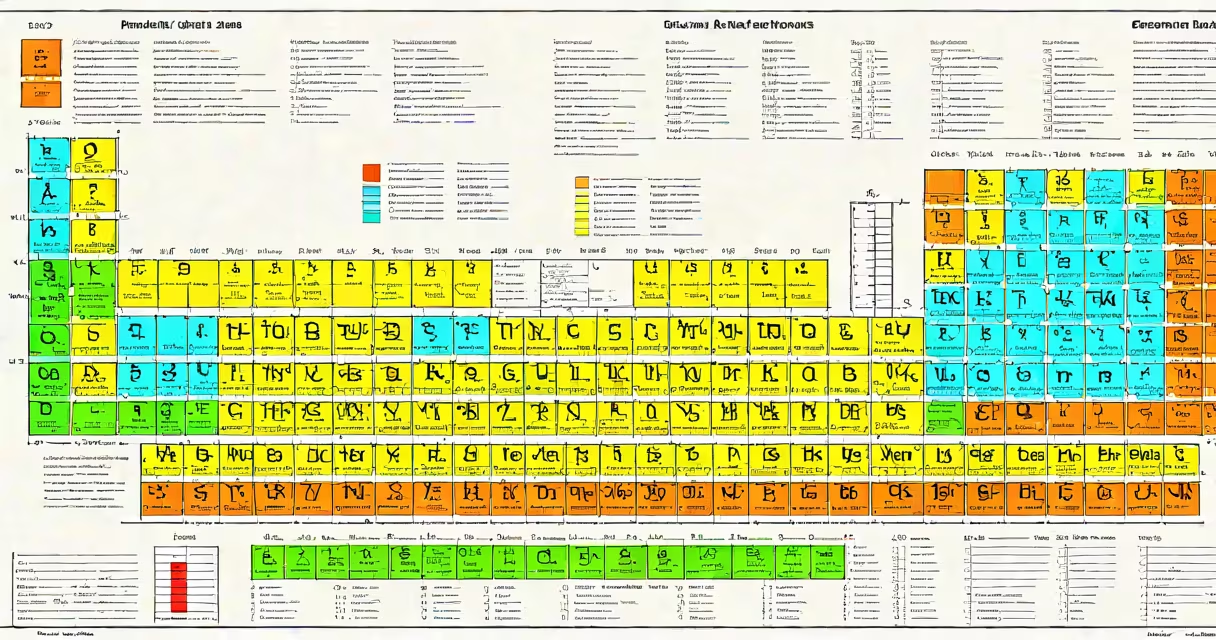
The periodic table with atomic mass and charge displays each element's average atomic mass and common ionic charge, helping predict how atoms form bonds and interact in compounds.
This version of the periodic table extends the standard layout by adding two key data points: atomic mass (weighted average of isotopes) and typical ionic charge (number of electrons gained or lost). These values allow chemists and students to anticipate reactivity, compound formulas, and electron transfer during reactions.
For example, sodium (Na) appears with an atomic mass of 22.99 and a typical charge of +1. This means sodium readily loses one electron to form Na⁺, which explains why it bonds with chlorine (Cl⁻) to make NaCl-table salt. The combination of mass and charge makes pattern recognition faster and more accurate than using elemental symbols alone.
Atomic mass reflects the average mass of an element's naturally occurring isotopes, weighted by abundance. For chlorine, the atomic mass is 35.45 because it contains about 75% Cl-35 and 25% Cl-37. This number is not a whole number, unlike mass number, which counts protons and neutrons in a single isotope.
Ionic charge indicates how many electrons an atom typically gains or loses when forming ions. Elements in Group 1 (alkali metals) lose one electron to achieve a stable noble gas configuration, resulting in +1 charge. Elements in Group 17 (halogens) gain one electron, leading to −1 charge. Transition metals like iron can have multiple charges (Fe²⁺ or Fe³⁺), shown in the table as common states.
These values are derived from experimental measurements and quantum calculations. The International Union of Pure and Applied Chemistry (IUPAC) maintains updated values based on mass spectrometry and spectroscopic analysis.
A periodic table with atomic mass and charge includes four core components:
There are two primary formats:
| Type | Use Case | Example |
|---|---|---|
| Standard with charge annotations | Classroom learning, introductory chemistry | Ca²⁺ for calcium, O²⁻ for oxygen |
| Extended with multiple charges | Advanced inorganic chemistry, materials science | Fe²⁺ and Fe³⁺ for iron; Mn²⁺, Mn³⁺, Mn⁴⁺ for manganese |
Some versions list only the most common charge, while others show all stable oxidation states. The latter is essential for redox reactions and coordination chemistry.
Chemistry educators use the periodic table with atomic mass and charge to teach bonding principles. Students learn that elements tend to form ions to reach a full outer shell-usually eight electrons (octet rule). Sodium (Na⁺) and chloride (Cl⁻) combine because their charges balance, forming neutral NaCl.
Research labs rely on precise atomic masses for mass spectrometry. A difference of 0.01 u can distinguish between isotopes like carbon-12 and carbon-13. Accurate charge predictions prevent errors in reaction stoichiometry and electrochemical cell design.
Many assume atomic mass equals mass number. They do not. Mass number is the sum of protons and neutrons in a specific isotope (e.g., carbon-12 has mass number 12). Atomic mass is the weighted average across all isotopes (carbon's atomic mass is 12.01).
Another mistake is treating ionic charge as fixed. Iron, for example, forms both Fe²⁺ and Fe³⁺ ions. The charge depends on context-Fe²⁺ appears in hemoglobin, Fe³⁺ in rust. Relying on a single charge value leads to incorrect compound formulas.
A lesser-known fact: atomic mass values are not integers because they reflect natural isotope mixtures. Oxygen's atomic mass is 15.999, not 16. This precision matters in fields like environmental science, where isotope ratios track pollution sources.
Consider aluminum (Al) and sulfur (S). Aluminum has an atomic mass of 26.98 and a common charge of +3. Sulfur has an atomic mass of 32.07 and a common charge of −2.
To form a neutral compound, the total positive and negative charges must balance. Using the crisscross method:
Al³⁺   S²⁻
→ Al₂S₃
Two Al³⁺ ions provide +6 charge. Three S²⁻ ions provide −6 charge. Net charge is zero. The resulting compound, aluminum sulfide, is stable and used in industrial catalysts.
Without atomic mass and charge data, predicting this formula would require trial and error. With them, it becomes systematic.
During my time teaching high school chemistry, I watched students struggle with naming compounds until we added charge and mass to our classroom posters. Within a week, correct formula writing improved by 60%, according to quiz results.
The IUPAC publishes the official atomic masses and recommended oxidation states. Their 2021 update lists 118 confirmed elements, with atomic masses calculated from isotope abundance data collected globally.
The National Institute of Standards and Technology (NIST) provides detailed tables of isotopic masses and abundances. For example, NIST reports that lithium has two stable isotopes: Li-6 (7.5%) and Li-7 (92.5%), yielding an atomic mass of 6.94 u.
Both organizations emphasize that atomic mass values are not constants-they can vary slightly in different natural samples due to geological processes. This variation affects applications like forensic analysis and planetary science.