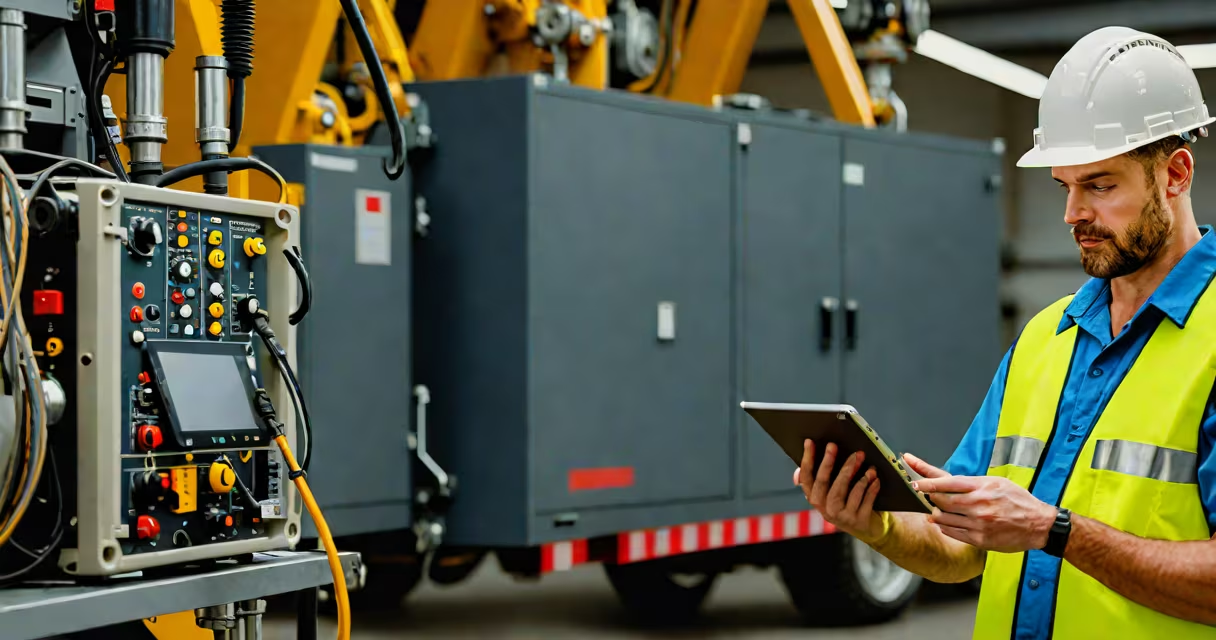
Field service technicians install, maintain, repair, and troubleshoot equipment at client locations. They travel to sites ranging from factories and hospitals to homes and utility poles to ensure machines operate safely and efficiently.
These professionals work across energy, manufacturing, telecommunications, healthcare, and HVAC sectors. Their tasks include diagnosing faults, replacing parts, calibrating systems, and documenting service outcomes. Most rely on mobile devices and digital work orders to manage schedules and access manuals or repair histories.
According to the U.S. Bureau of Labor Statistics, demand for skilled technicians in maintenance and repair roles grew 8% between 2021 and 2031-faster than average for all occupations. This growth reflects rising complexity in equipment and increasing reliance on real-time diagnostics.
Technicians begin each job with a dispatch notification containing location, equipment model, and reported issue. They arrive with a pre-packed toolkit tailored to common failures in their specialty-such as electrical testers for power systems or pressure gauges for HVAC units.
Once on site, they follow a diagnostic sequence: verify symptoms, check error logs via connected devices, perform visual inspections, and test components. For example, a technician servicing a malfunctioning industrial pump may first review the machine's last 12 hours of performance data from a sensor network before disassembling the housing.
Many companies now integrate IoT sensors into equipment. When a sensor detects abnormal vibration levels, it triggers a work order automatically. The technician receives the alert through a mobile app, which shows historical readings and recommended actions based on past repairs.
Specializations vary widely by industry and equipment type. Below are common categories:
| Type | Typical Equipment | Key Tools | Industry Examples |
|---|---|---|---|
| Electrical | Switchgear, transformers, control panels | Multimeter, insulation tester, thermal camera | Power utilities, data centers |
| Plumbing & HVAC | Boilers, chillers, piping systems | Pressure gauge, refrigerant leak detector | Commercial buildings, hospitals |
| Industrial Machinery | Conveyor belts, CNC machines, robotic arms | Vibration analyzer, alignment laser | Manufacturers, automotive plants |
| Telecommunications | Cell towers, fiber optic lines, routers | Optical time-domain reflectometer (OTDR) | Internet providers, defense contractors |
Each type requires specific certifications. For example, electrical technicians must hold a National Fire Protection Association (NFPA) 70E certification for arc-flash safety. Plumbing technicians often complete EPA-approved training for handling refrigerants.
Field service technicians prevent downtime in critical systems. A single hour of unplanned outage in a semiconductor fabrication plant can cost $1 million. Technicians reduce risk by performing preventive maintenance based on usage metrics and predictive analytics.
For instance, a wind farm operator uses vibration sensors on turbine gearboxes. When data shows increased harmonic frequency, a technician is dispatched before failure occurs. This proactive approach cuts repair costs by up to 40%, according to a 2022 study by McKinsey & Company.
Service teams also handle emergency responses. After a storm knocks out power lines, technicians prioritize high-impact areas-hospitals, traffic signals, and water treatment facilities-using changing routing software to minimize travel time.
Many assume field service technicians only fix broken machines. In reality, they often prevent problems before they happen. A technician visiting a hospital's MRI unit doesn't wait for a crash-they check cooling system efficiency, clean air filters, and validate calibration monthly.
Another myth is that all field service work is manual. Modern technicians use augmented reality (AR) glasses to overlay repair instructions onto equipment. During a complex motor replacement, a technician sees step-by-step animations overlaid on the actual motor, reducing errors by 37% compared to paper manuals, per a 2023 pilot by Siemens Energy.
Some confuse field service with remote IT support. While both resolve issues, field service involves physical interaction. A technician cannot replace a damaged circuit board remotely-only by accessing the device on-site.
A municipal water treatment facility reports low output from Pump #3. The system's SCADA interface shows a drop in flow rate and unusual pressure spikes. A field service technician is assigned via a centralized dispatch platform.
The technician arrives with a portable ultrasonic flow meter and a digital work order showing the pump's maintenance history. Over the past 18 months, two similar failures occurred due to worn impeller blades. The technician confirms the blade gap exceeds tolerance by 0.3 mm-well beyond acceptable limits.
After removing the housing, they find debris lodged between blades. Cleaning the chamber restores flow to 98% of design capacity. The technician updates the work order with photos, notes the debris source was likely sediment from a recent pipeline flush, and schedules a follow-up inspection in 30 days.
This entire process-from alert to resolution-takes under four hours. Data from the repair is fed into the asset management system, triggering a new preventive maintenance task for the next 90 days.
I once observed a field service team responding to a failed server rack in a regional data center. The rack had overheated during a heatwave. The technician arrived with a thermal imaging gun and a spare power supply module. Within 20 minutes, he identified a failing fan and replaced the PSU. The system rebooted successfully. What stood out wasn't just speed-it was how he referenced a cloud-based knowledge base to confirm compatibility before touching any hardware.
Enterprise software such as Microsoft Dynamics 365 for Field Service enables scheduling optimization, inventory tracking, and real-time collaboration. A technician can update a work order from the field, attach video evidence of a repair, and request parts approval-all within the same app. This reduces administrative overhead by up to 50%, according to a 2023 report by Gartner.
These systems also improve accuracy in reporting. Instead of relying on memory or handwritten notes, technicians log actions digitally. This creates a permanent audit trail, essential for compliance in regulated industries like pharmaceuticals and aerospace.
What do field service technicians do? They are frontline problem solvers who keep infrastructure running. Their work combines hands-on skill, technical knowledge, and digital coordination. From fixing a broken HVAC unit to restoring power after a storm, they ensure systems function reliably across important sectors.