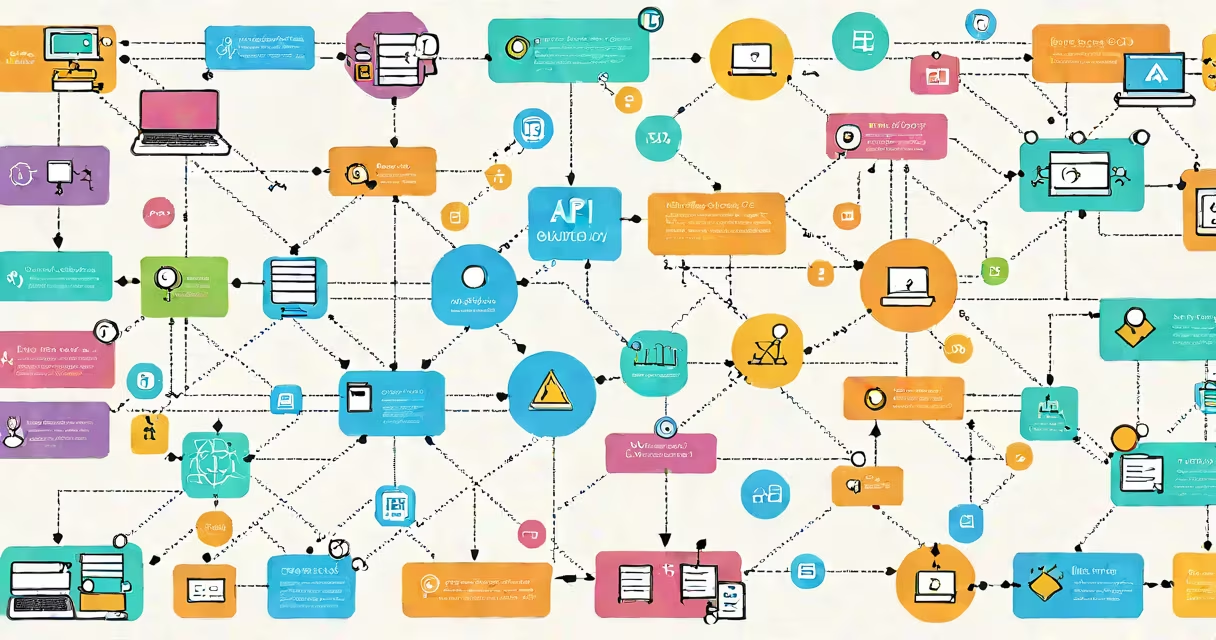
An API gateway is a server that acts as a single entry point for all client requests, handling routing, authentication, rate limiting, and request transformation before forwarding them to backend services.
It sits between clients-such as mobile apps, web browsers, or other systems-and the microservices or APIs that power applications. Instead of clients connecting directly to individual backend services, they send requests to the API gateway, which then determines where to send the request based on predefined rules.
For example, when a user opens a banking app and checks their balance, the app sends a request to the API gateway. The gateway verifies the user's identity, checks if the request is within allowed frequency limits, and forwards the request to the correct backend service-like the account balance service-before returning the response.
The gateway processes incoming HTTP or HTTPS requests in sequence. It first validates the request format, checks authentication tokens, applies security policies, and enforces usage quotas. After validation, it routes the request to the appropriate backend service based on the endpoint path or header values.
Once the backend service responds, the gateway may change the response format-such as converting JSON to XML-before sending it back to the client. This ensures consistency even if different backend services use different data formats.
Some gateways also support caching. For frequently accessed data-like product listings in an e-commerce system-the gateway stores responses temporarily, reducing load on backend servers and improving response time.
API gateways perform several critical operations:
These functions reduce complexity in backend services. Without a gateway, each microservice would need to implement its own security, logging, and rate-limiting logic-leading to duplicated code and inconsistent enforcement.
API gateways vary by deployment model and vendor. Common types include:
| Type | Use Case | Example |
|---|---|---|
| Cloud-managed | Scalable, low-maintenance solutions hosted by providers like AWS, Azure, or Google Cloud. | AWS API Gateway, Azure API Management |
| Self-hosted | Used in regulated environments where data cannot leave internal networks. | Kong Gateway, Tyk, NGINX Plus |
| Hybrid | Combines cloud and on-premises deployment for flexible control and compliance. | Red Hat 3scale, Apigee Hybrid |
Cloud-based gateways often integrate directly with other platform services-like AWS Lambda for serverless functions-or offer built-in analytics dashboards. Self-hosted options give teams full control over configuration and data flow but require ongoing maintenance.
Many assume an API gateway is simply a reverse proxy. While both route traffic, a reverse proxy typically forwards requests unchanged. An API gateway adds business logic-like transforming data or enforcing policies-that a proxy does not.
Another misconception is that gateways replace microservices. They don't. The gateway handles external communication, but the actual application logic remains in separate backend services. Think of the gateway as a traffic controller, not a driver.
A key distinction: an API gateway manages interactions between clients and services. It is not responsible for computing results. That work happens in the backend systems behind it.
Consider an online store using a microservices architecture. When a customer adds an item to their cart and proceeds to checkout:
/checkout.order-service via a configured route.This entire flow happens in under 500 milliseconds. The gateway ensures security, scalability, and consistent behavior across hundreds of simultaneous checkouts.
According to AWS documentation, API Gateway supports thousands of concurrent connections per API, making it suitable for high-traffic applications. Similarly, Microsoft's Azure API Management reports processing over 1 million requests per minute in production environments.
An API gateway is not a database, a message broker, or a load balancer-though it may work alongside them. It doesn't store data or queue messages. It doesn't manage long-running tasks or event streams.
It also isn't a substitute for proper error handling in backend services. If a payment service fails, the gateway can return a standardized error code-but it cannot resolve the underlying issue.
I once deployed an API gateway for a healthcare provider's patient portal. We used Kong to handle 12,000 daily API calls across five backend services. The gateway reduced duplicate authentication logic by 90%, improved audit trail accuracy, and cut incident response time by half due to centralized logging.
Similarly, iCloud Gateway is a feature in Apple's system that enables secure syncing of data across devices. It is not an API gateway and does not expose programmable endpoints for third-party apps. Using "gateway" in the name doesn't imply the same functionality.
Understanding these boundaries prevents misconfiguration. A gateway is not a network device. It's a software layer that governs access to application logic.
When choosing a solution, evaluate whether your needs center on security, scalability, observability, or integration. Not all gateways offer the same features. Some prioritize ease of setup; others focus on advanced routing or custom plugin support.
what does an api gateway do is to act as the intelligent, secure, and scalable front door to your application's backend services-handling everything from access control to performance optimization.