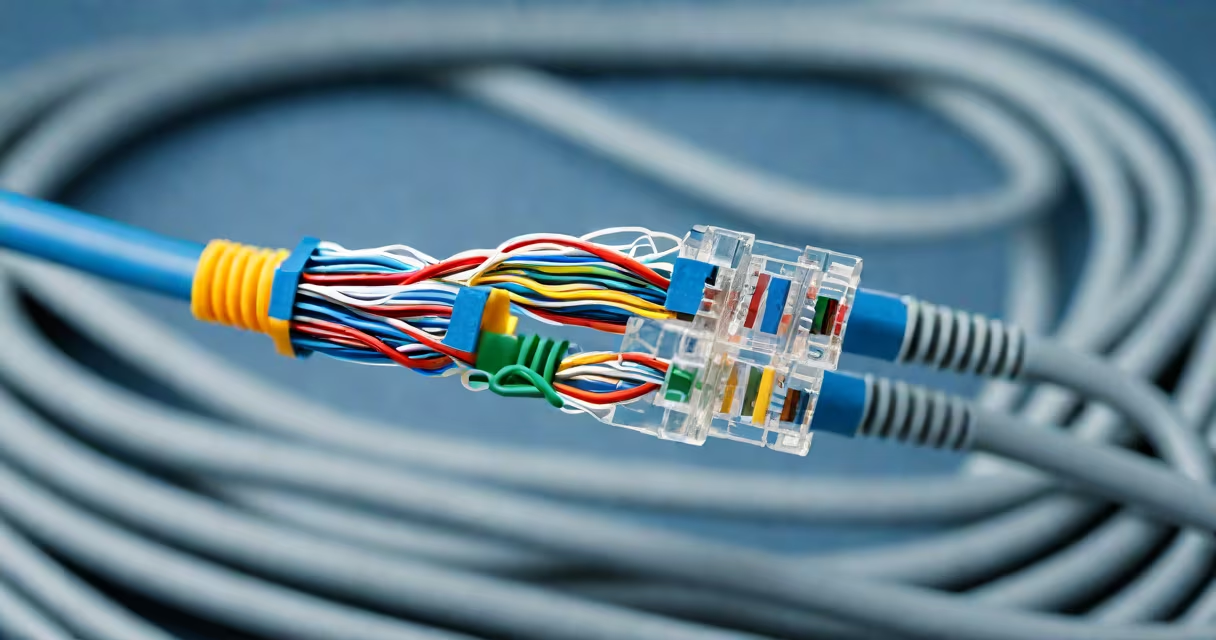
Category 6 cable, or Cat 6, is a standardized twisted-pair Ethernet cable designed to support data transfer rates up to 10 gigabits per second over distances up to 55 meters. It improves upon earlier standards like Cat 5e by reducing crosstalk and electromagnetic interference, making it ideal for high-performance local area networks.
Cat 6 cable uses four pairs of copper wires, each twisted to minimize signal degradation. The tighter twist rate and improved insulation reduce crosstalk between pairs-electrical interference that distorts signals. This allows for consistent performance even under heavy network loads. The cable's outer jacket often includes a spline, a plastic separator that keeps the wire pairs physically separated, further suppressing interference.
According to the Telecommunications Industry Association (TIA), Cat 6 cables are rated for frequencies up to 250 MHz, higher than Cat 5e's 100 MHz limit. This frequency boost enables higher bandwidth and better signal integrity, especially in environments with dense wiring or nearby electrical equipment.
Each Cat 6 cable contains four twisted pairs of insulated copper conductors. These pairs are twisted at different rates to prevent electromagnetic interference from coupling between adjacent pairs. When data travels through the cable, electrical pulses represent binary signals-ones and zeros-sent along the wire pairs.
The cable's shielding, when present, adds another layer of protection. Shielded Cat 6 (S/FTP or STP) features a foil wrap around each pair and an braided shield, which reduces external noise and crosstalk. Unshielded Cat 6 (UTP) relies solely on twisting and spacing to maintain signal quality.
For maximum performance, Cat 6 cables must be terminated correctly using RJ-45 connectors. Poor termination-such as leaving wires untwisted past the connector-can degrade signal quality and cause errors. Proper installation requires tools like a crimping tool and a cable tester to verify continuity and performance.
There are three primary variants of Cat 6 cable, differing in shielding and application:
| Type | Shielding | Use Case | Performance Advantage |
|---|---|---|---|
| UTP (Unshielded) | None | Home offices, small businesses | Lower cost, easier to install |
| F/UTP (Foil Shielded) | Foil wrap around all four pairs | Commercial buildings, moderate EMI risk | Reduces crosstalk; good for long runs |
| S/FTP (Screened Foil Twisted Pair) | Foil around each pair + braid shield | Data centers, industrial settings | Best noise immunity; supports 10 Gbps reliably |
While UTP Cat 6 is sufficient for most residential and small office setups, S/FTP is recommended for environments with high electromagnetic noise-like near motors, fluorescent lighting, or power lines. A real-world example: a hospital IT department replaced UTP Cat 6 in imaging rooms with S/FTP to eliminate signal distortion during MRI data transfers.
Modern networks rely on Cat 6 for applications demanding speed and stability. It's standard in new home installations, business LANs, and server room backbones. For example, a university campus upgraded its dormitory Wi-Fi infrastructure using Cat 6 cabling to support 10 Gbps switches, enabling students to stream 4K video and run virtual machines simultaneously.
It's also used in structured cabling systems that follow ANSI/TIA-568 standards. These systems define how cables are routed, labeled, and tested to ensure reliability. A properly installed Cat 6 system includes patch panels, wall jacks, and cable management trays-all designed to maintain signal integrity over time.
One non-obvious fact: Cat 6 cables are backward compatible with older devices. A Cat 6 cable plugged into a Cat 5e router still works-but at Cat 5e speeds. The cable doesn't force higher performance; it only enables it when both ends support it. This compatibility makes Cat 6 a practical upgrade path without replacing existing hardware.
Cat 6 is often mistaken for Cat 6a, which offers extended frequency support (up to 500 MHz) and longer 10 Gbps reach (100 meters). While Cat 6a performs better in noisy environments, it's bulkier and more expensive. Many users assume Cat 6a is always superior-but for typical office or home use within 55 meters, Cat 6 delivers sufficient performance at lower cost.
Another confusion arises with Cat 8 cable. Cat 8 supports 40 Gbps over 30 meters but is designed for short-range data center connections, not general networking. Unlike Cat 6, it's not intended for wall outlets or long horizontal runs. Using Cat 8 in a home setup may result in unnecessary expense and complexity.
I once installed Cat 6 cabling in a small business with 12 workstations. The client initially wanted Cat 5e due to budget concerns. After testing both options, Cat 6 handled video conferencing and file backups without packet loss-while Cat 5e dropped frames during peak usage. The upgrade paid for itself in reduced downtime.
Compared to Cat 3 cable, Cat 6 supports far higher frequencies and data rates. Cat 3 was designed for voice and low-speed data (up to 10 Mbps), making it obsolete for modern networks. For context, Cat 3 is still used in legacy telephone systems, but not for internet or network traffic.
When compared to Cat 5e, Cat 6 offers better performance under load. Both support 1 Gbps, but Cat 6 handles 10 Gbps over shorter distances. In a test conducted by the National Institute of Standards and Technology (NIST), Cat 6 cables maintained error-free transmission at 10 Gbps over 55 meters, while Cat 5e failed at 40 meters under similar conditions.
For those considering future-proofing, Cat 6 remains a solid choice. It's widely available, affordable, and meets current and near-term network demands. If you're setting up a new network, Cat 6 provides a balance of performance, cost, and longevity.
Understanding what is Cat 6 cable used for helps clarify its role in modern infrastructure. It's not just a wire-it's a foundation for reliable, high-speed communication. Whether connecting a single workstation or building a corporate network core, Cat 6 delivers proven results.