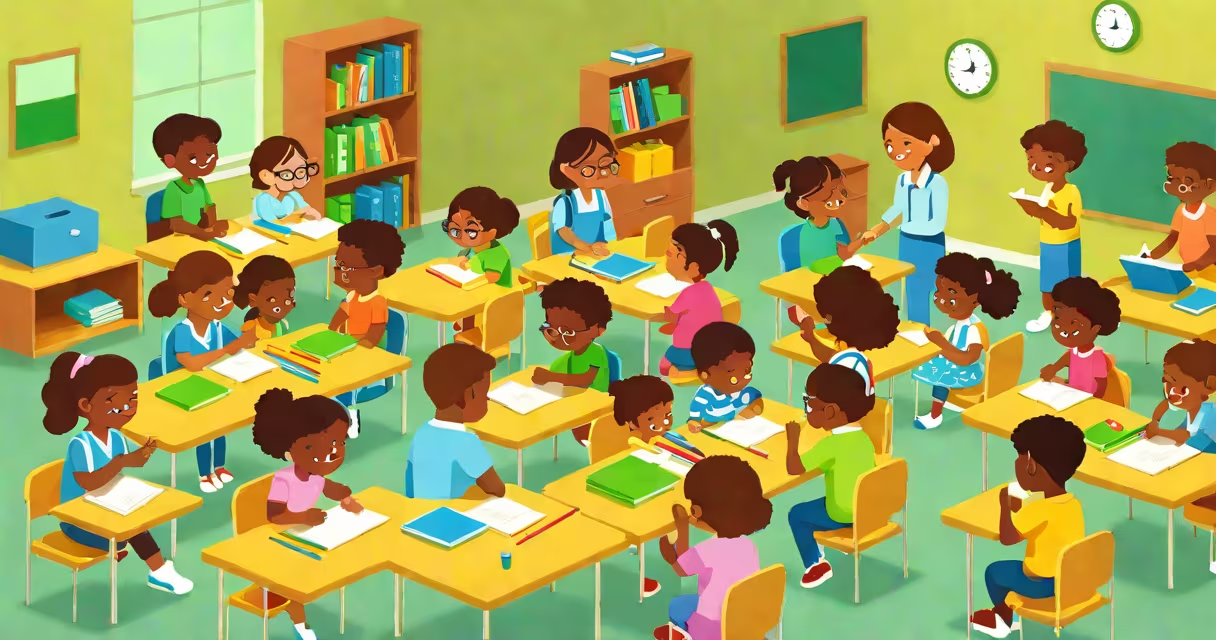
Universal pre-K is a publicly funded early childhood education program that offers free, high-quality preschool to all children aged 3 and 4, regardless of family income or background. It aims to close developmental gaps before kindergarten by providing structured learning environments focused on social-emotional development, language acquisition, and foundational academic skills.
Unlike means-tested pre-K programs that restrict access based on household income, universal pre-K enrolls every eligible child in a designated age group. The model aims to serve entire communities, not just low-income families. States and cities such as New York City, Boston, and Oklahoma have implemented universal pre-K systems with measurable outcomes in school readiness and long-term achievement.
Research from the National Institute for Early Education Research (NIEER) shows that children who attend high-quality pre-K programs enter kindergarten with stronger vocabulary, math, and executive function skills. These gains persist through elementary school and are especially pronounced among children from under-resourced communities.
Universal pre-K operates through state or local government funding, often integrated into public school districts. Children typically attend full-day or half-day sessions during the academic year, following a curriculum aligned with state early learning standards. Teachers are required to hold early childhood education credentials, and classrooms maintain low student-to-teacher ratios-usually 10:1 or better.
Programs are delivered through public schools, licensed childcare centers, or community-based organizations approved by state education departments. Parents do not pay tuition, though some may cover optional extras like transportation or meals. Participation is voluntary, but enrollment is encouraged to ensure broad access.
In New York City, for example, over 70,000 three- and four-year-olds attend universal pre-K annually. The city contracts with over 1,000 sites across all five boroughs, including private nonprofit providers. Class sizes average 16 students per classroom, with two adults present. All teachers must have at least a bachelor's degree in early childhood education or a related field.
While the core principle remains consistent-free access for all children in a target age group-implementation varies by location. The most common models include:
| Model Type | Delivery Method | Example Location | Key Features |
|---|---|---|---|
| Public School-Based | Integrated into district K-12 system | New York City, Boston | Full-day programming, standardized curriculum, teacher certification required |
| Statewide Mandate | State-funded, administered through local agencies | Oklahoma, Georgia | Free for all 4-year-olds, with state oversight and quality benchmarks |
| City-Run Program | Locally managed, often with mixed providers | Chicago, Washington D.C. | Contracted services from nonprofits and charter schools; flexible scheduling |
Each model prioritizes quality, equity, and accessibility. For instance, Oklahoma's program-launched in 1998-has served over 1 million children since inception and consistently ranks among the highest-performing states in early literacy and math outcomes.
Children who attend universal pre-K demonstrate improved school readiness. A 2021 study published in Child Development found that participants were 15% more likely to meet reading benchmarks by third grade compared to peers who did not attend. Gains were even larger for children from households below the poverty line.
Long-term benefits include reduced grade retention, lower special education placement rates, and higher high school graduation rates. The Brookings Institution estimates that every dollar invested in universal pre-K yields $7 in societal returns through increased workforce productivity and reduced public spending on remedial education and criminal justice interventions.
A key insight often missed: universal pre-K doesn't just help disadvantaged children-it benefits all families equally. When all children attend, schools see fewer achievement gaps, classrooms are more inclusive, and educators report greater preparedness for diverse learners. This collective benefit is a major reason why universal pre-K is gaining bipartisan support in several states.
Universal pre-K is frequently misunderstood as a form of daycare or babysitting. It is not. While both provide supervision, universal pre-K follows a research-based curriculum focused on cognitive, emotional, and physical development. Activities are intentionally designed to build executive function, problem-solving, and peer collaboration skills.
Another misconception is that universal pre-K replaces parental responsibility. On the contrary, it complements home learning. Parents remain central to their child's development. Programs often include family engagement components-such as monthly workshops, home visits, and parent-teacher conferences-to strengthen the connection between school and home.
There's also confusion about cost. Some assume universal pre-K requires massive tax increases. But many states fund it through existing education budgets, reallocated federal funds, or targeted revenue streams. In California, for example, the state uses a combination of general fund appropriations and federal grants to expand universal pre-K to 1.2 million children by 2025.
I visited a universal pre-K classroom in Portland, Oregon, during a morning circle time. Twenty-three children, ages 3 and 4, sat on colorful mats arranged in a semi-circle. The teacher read a story about sharing, then asked open-ended questions: "What happened when the boy gave his toy away?" "How did the other child feel?"
Children raised hands, offered responses in full sentences, and listened to each other. The teacher acknowledged all contributions and modeled respectful dialogue. Afterward, students chose from activity centers: building with blocks, painting, or playing pretend in a kitchen corner. Each center had clear rules and materials labeled with pictures and words.
This wasn't random play. It was intentional design. The teacher later explained that every activity was scaffolded to promote language development, fine motor control, and emotional regulation. The goal wasn't just fun-it was learning.
Universal pre-K is not a luxury or a niche service. It is a proven investment in early childhood development that prepares all children-regardless of background-for lifelong success. It is not limited to low-income families, nor is it merely childcare. It is structured, evidence-based education delivered at scale.
When people ask, "What is universal pre-K?" the answer lies in its name: universal, meaning available to everyone; pre-K, meaning early education before formal schooling begins. It is a foundational step toward equitable opportunity in education.