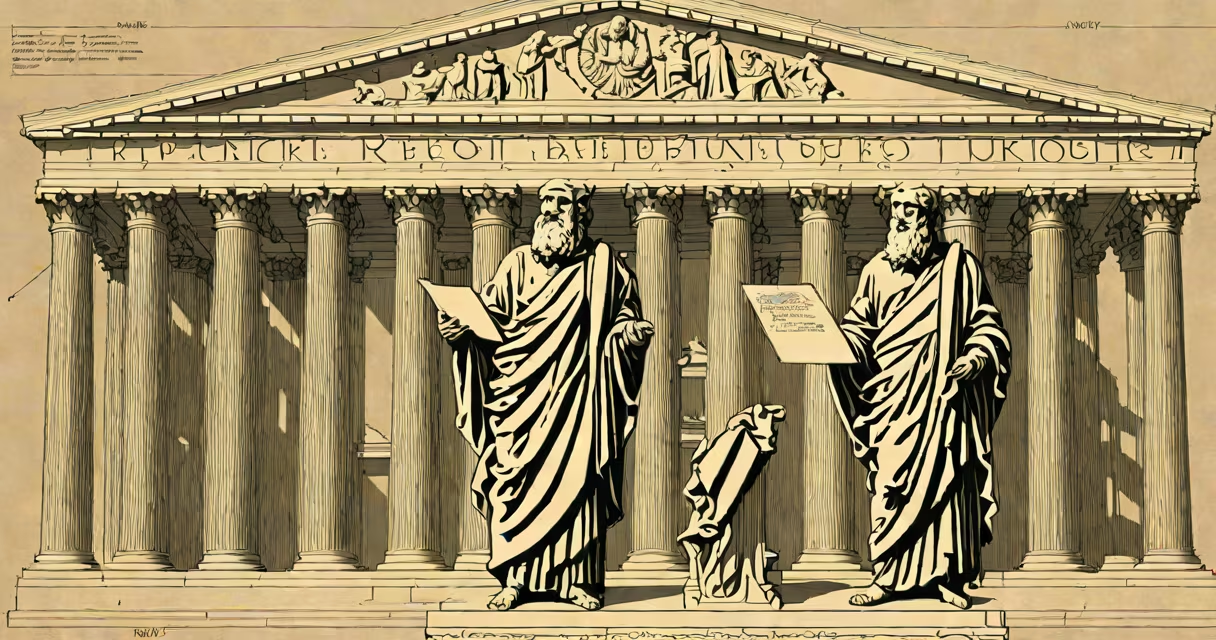
The Republic was written by Plato, a Greek philosopher born in 427 BCE. He composed it around 380 BCE as a Socratic dialogue exploring justice, the soul, and the structure of an ideal city-state.
Plato did not write The Republic as a political manual. Instead, he used a narrative structure where Socrates debates with others about whether justice is better than injustice, both in individuals and in societies. The work unfolds through conversations set in Athens during the Peloponnesian War, reflecting the instability of his time.
Plato's dialogues were not meant to be definitive statements. They present arguments, then challenge them. The Republic contains multiple layers: philosophical inquiry, ethical reasoning, and political theory-all embedded in dramatic form. This method allows readers to follow the logic of ideas rather than accept conclusions outright.
The Republic begins with a discussion on justice between Socrates and Cephalus, then shifts to Polemarchus and Thrasymachus, each offering different definitions. Thrasymachus claims justice is merely the advantage of the stronger-a view Socrates refutes through logical argumentation.
After dismantling these views, Socrates constructs a model city-state based on division of labor and class roles: rulers (philosopher-kings), guardians (warriors), and producers (farmers, artisans). He argues that justice arises when each person performs their proper function and no one interferes with another's role.
This model leads to the famous metaphor of the cave-the allegory of the prisoner who sees only shadows until he escapes and sees reality. The allegory illustrates the philosopher's process from ignorance to enlightenment, reinforcing the idea that only those who understand the Forms (eternal truths) should rule.
The Republic consists of ten books, each focusing on a specific theme. Book I introduces the debate on justice. Books II-IV develop the theory of the tripartite soul and the ideal state. Books V-VII explore education, the role of women, and the philosopher-king. Books VIII-X examine corrupt forms of government and the immortality of the soul.
Each book builds on the last. For example, Book V discusses the abolition of private property among guardians and the communal raising of children-radical ideas for ancient Greece. These proposals stem from the belief that personal interests undermine public good.
Plato uses metaphors extensively. The sun represents the Form of the Good-the highest principle. The divided line illustrates levels of knowledge: imagination, belief, mathematical reasoning, and philosophical understanding. These tools make abstract concepts tangible.
The Republic remains central to Western philosophy. It is studied in universities worldwide, especially in courses on ethics, political theory, and epistemology. Students analyze its arguments on justice, leadership, and human nature.
Modern applications include critiques of democracy. Plato warns that democratic systems favor popularity over wisdom. His concern-that leaders are chosen by vote rather than knowledge-resonates in contemporary debates about expertise versus populism.
For example, in 2020, a study published in Political Theory journal examined how Plato's vision of philosopher-rulers relates to current discussions about technocracy and expert governance. The authors noted that while direct rule by philosophers is impractical, the underlying demand for informed leadership persists.
Many assume The Republic is a blueprint for a real government. It is not. Plato never intended it as a policy document. Its purpose is to provoke thought, not prescribe action.
Another misconception is that Plato opposed democracy entirely. He criticized mob rule and emotional decision-making, but he valued civic participation when guided by reason. His ideal state includes structured debate and education-not suppression of speech.
A key correction: The Republic is not a treatise on utopia. It is a critique of existing power structures. When Socrates describes the ideal city, he often shows how it collapses under pressure-highlighting the fragility of even well-designed systems.
For instance, in Book VIII, Plato outlines four degenerate forms of government: timocracy (honorable rule), oligarchy (wealth-based rule), democracy (freedom-focused), and tyranny (absolute rule). He traces how each arises from flaws in the previous system. This progression reveals his interest in systemic failure, not perfection.
Philosophers interpret The Republic in different ways. Here are three major approaches:
| Interpretation Type | Core Idea | Key Scholar |
|---|---|---|
| Authoritarian | Plato supports strict hierarchy and censorship for social stability. | Leo Strauss (1950s) |
| Liberal | Plato critiques authoritarianism through irony; his ideal state is a warning. | Thomas C. Brickhouse & Nicholas D. Smith (1994) |
| Radical | Plato's vision of shared property and gender equality challenges patriarchal norms. | Penelope M. Gardner (2008) |
These interpretations show that The Republic resists single readings. Scholars continue to debate whether Plato believed in the feasibility of his ideal society-or whether he used it to expose the limits of human reason.
I once attended a live reading of The Republic at the University of Chicago's Classics Department. A group of graduate students performed the dialogue in English, using period costumes and minimal staging. What struck me was how the tension between characters felt immediate-even centuries later. When Socrates questioned Thrasymachus' claim that "might makes right," the room fell silent. That moment revealed how useful the text still is when spoken aloud.
Plato never claimed authorship of The Republic in the way modern writers do. Ancient manuscripts attribute it to him based on tradition, not a signature. The title "Republic" itself is a later Latin translation-Plato called it Politeia, meaning "constitution" or "form of government." The word "republic" entered English via Roman usage, not Greek.
Plato likely wrote The Republic during his middle period. He composed other dialogues like Phaedo and Apology earlier, and Timaeus and Critias later. The Republic sits at the center of his corpus, bridging early explorations of virtue and later reflections on cosmology and myth.
Consider the allegory of the cave. A prisoner is chained inside a cave, facing a wall. Behind him, a fire casts shadows of people carrying objects. The prisoner sees only shadows and believes they are real. When freed, he exits into sunlight and sees actual objects. He returns to tell the others-but they reject him.
This story illustrates the philosopher's process: from illusion to truth. It also shows why Plato believed most people resist enlightenment. The cave symbolizes the unexamined life. The escape represents education. The rejection reflects societal resistance to new ideas.
Today, educators use this analogy to describe critical thinking. A high school teacher in New York reported that after teaching the allegory, 68% of her students said they began questioning media narratives they once accepted uncritically. The example proves how ancient ideas remain relevant.
Plato's influence extends beyond philosophy. The term "philosopher-king" appears in political discourse, even in modern elections. In 2016, a U.S. Senate candidate referenced Plato's ideal ruler in a campaign speech, arguing that leaders should be trained in ethics and wisdom-not just rhetoric.
Understanding who wrote The Republic matters because it clarifies the origins of enduring questions: Who should govern? What is justice? Can we know truth? These are not solved problems-they are living debates shaped by Plato's work.