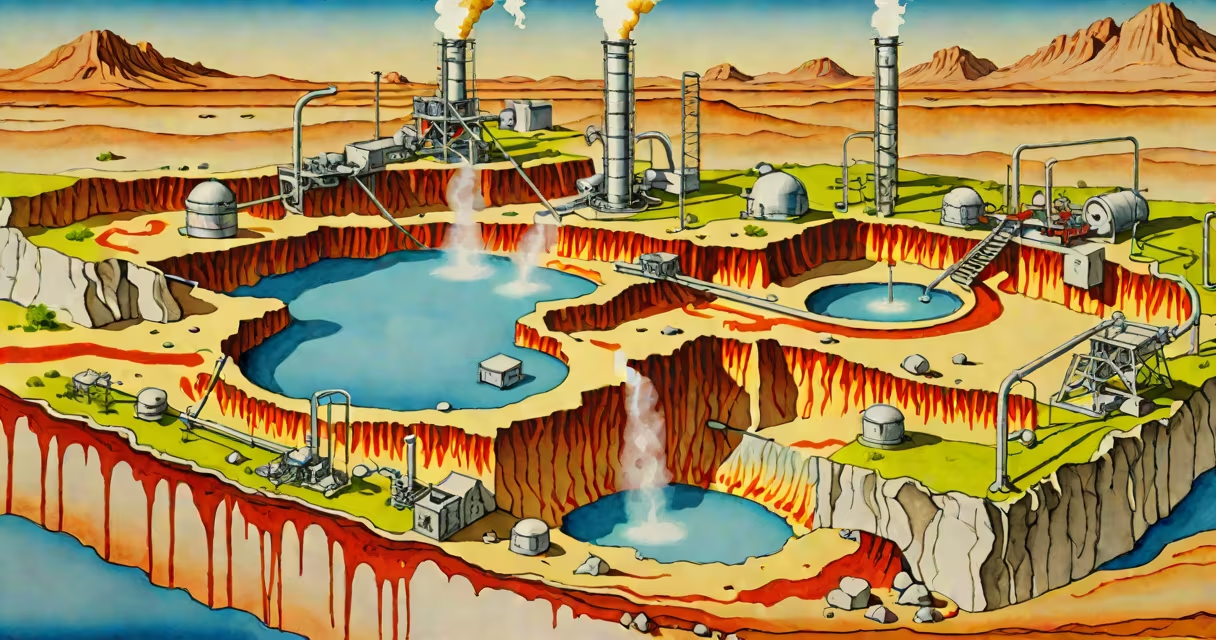
Future geothermal energy refers to advanced methods of extracting heat from deep within the Earth to generate electricity and provide heating, using enhanced drilling, reservoir engineering, and AI-driven monitoring to expand access beyond traditional volcanic zones.
Geothermal energy uses natural heat from Earth's core-generated by radioactive decay and residual planetary formation energy-to produce steam that drives turbines. Traditional systems rely on naturally occurring hydrothermal reservoirs near tectonic boundaries. Future geothermal energy moves beyond those constraints through engineered systems that create artificial reservoirs in hot dry rock, enabling deployment in stable continental regions like the Midwest U.S., Germany, and parts of China.
Unlike solar and wind, which depend on weather and time of day, geothermal plants operate continuously at 90%+ capacity factor. This stability makes them ideal for baseload power-supplying consistent electricity even when other renewables aren't producing. The U.S. Department of Energy estimates that enhanced geothermal systems (EGS) could supply up to 10% of national electricity demand by 2050, assuming breakthroughs in drilling efficiency and reservoir stimulation.
Traditional geothermal plants draw steam or hot water from underground aquifers heated by nearby magma. These systems require specific geological conditions: permeable rock layers, high fluid saturation, and proximity to crustal fractures. Only about 1% of Earth's land area meets these criteria, limiting widespread adoption.
Future geothermal energy relies on enhanced geothermal systems (EGS), where engineers drill deep boreholes-typically 3 to 10 kilometers below the surface-into hot, impermeable rock. Water is injected under pressure to fracture the rock and create a network of channels. As the water circulates through these fractures, it absorbs heat and returns to the surface as superheated fluid, which powers turbines.
A key innovation is closed-loop systems, which circulate fluid through sealed pipes embedded in bedrock. These avoid water loss and reduce the risk of induced seismicity. A pilot project in Fenton, Missouri, demonstrated that closed-loop systems can deliver 1 megawatt of continuous power from a single well pair, sufficient to serve 1,000 homes annually.
Three primary approaches define future geothermal energy development:
| Type | How It Works | Use Case Example | Limitations |
|---|---|---|---|
| Natural hydrothermal | Uses existing hot water reservoirs | Iceland's Hellisheiði plant powers 90% of Reykjavík | Limited to tectonically active zones |
| Enhanced geothermal (EGS) | Creates artificial reservoirs via hydraulic fracturing | U.S. DOE's FORGE site in Utah tests EGS performance | Higher upfront cost; risk of microseismic events |
| Closed-loop systems | Fluid circulates in sealed pipes; no injection or extraction | Fenton, Missouri pilot delivers 1 MW with no water withdrawal | Lower thermal output per well; still scaling |
Recent advances in directional drilling and fiber-optic sensing allow precise targeting of hot zones. For example, a 2023 test in Nevada used real-time temperature mapping to adjust drilling angles mid-process, reducing deviation by 60% compared to conventional methods.
AI models now predict reservoir behavior months in advance. At the Soultz-sous-Forêts site in France, machine learning algorithms analyzed 15 years of pressure and flow data to improve injection rates, increasing system lifespan by 22%.
Future geothermal energy is being deployed in regions lacking access to other renewable resources. In Germany, where solar potential is moderate and wind patterns are inconsistent, the city of Munich partnered with energy firm E.ON to install district heating networks powered by shallow geothermal loops. These systems extract heat from 100-meter-deep boreholes to warm buildings year-round, cutting carbon emissions by 40% compared to gas heating.
In India, the Ministry of New and Renewable Energy launched a pilot program in Tamil Nadu to explore EGS feasibility in granite-rich terrain. Initial simulations suggest that a single 5-kilometer-deep well could supply 50 megawatts of power-enough for a medium-sized town-without relying on external water sources.
One non-obvious fact: future geothermal systems can co-locate with carbon capture. A prototype in Wyoming injects CO₂ into geothermal reservoirs, where it dissolves into brine and remains trapped under pressure. This dual-purpose model reduces emissions while boosting reservoir productivity by increasing fluid density and heat transfer efficiency.
Many confuse future geothermal energy with current geothermal projects. While both use Earth's heat, traditional systems depend on rare natural conditions. Future geothermal systems are engineered-they don't wait for nature to provide a ready-made reservoir. They actively create the environment needed for energy extraction.
Another misconception is that geothermal energy is inherently expensive. Early EGS projects had high capital costs due to deep drilling. But recent innovations have reduced drilling expenses by 40% since 2018. According to the International Renewable Energy Agency (IRENA), levelized cost of electricity (LCOE) for EGS could fall below $0.05/kWh by 2035, making it competitive with fossil fuels in many markets.
Some assume geothermal plants cause significant earthquakes. While hydraulic fracturing can trigger microseismic events, monitoring shows most are below magnitude 1.0-too small to be felt. The U.S. Geological Survey confirms that EGS operations in Nevada and Utah have not caused measurable damage to infrastructure.
The U.S. Department of Energy's Frontier Observatory for Research in Geothermal Energy (FORGE) in Utah serves as a living lab for future geothermal energy. Researchers drilled two wells 3.5 kilometers deep into granite formations, then injected water at pressures exceeding 100 bars to induce fractures. After six months, they measured sustained heat exchange rates of 250 watts per meter of borehole-exceeding early projections.
They also tested a novel technique called "hydraulic fracturing with nanoparticles." By adding silica-based particles to the injection fluid, they improved fracture conductivity by 35%. This method reduced the need for multiple injection cycles, lowering operational costs and environmental impact.
During a 2023 field trial, the system generated 1.2 megawatts of power continuously for 72 hours. Data from this run helped refine predictive models used in planning future plants across the Great Basin region.
I visited the FORGE site in person during a summer research visit. Standing beside the 4-kilometer-deep borehole, I heard the faint hum of pumps circulating fluid through the subsurface. The air was cool, the ground still. Yet beneath my feet, temperatures exceeded 300°C. That contrast-surface calm, deep heat-made the promise of future geothermal energy feel tangible, not theoretical.
Future geothermal energy is not a distant dream. It's being built today in labs, test sites, and pilot programs. With better drilling, smarter reservoir management, and integration with other clean technologies, it can become a central pillar of decarbonized energy systems worldwide.
Understanding future geothermal energy reveals a path to stable, clean power independent of weather or fuel supply chains. Its potential extends beyond electricity-it can provide industrial heat, support carbon storage, and enable climate-resilient urban development. As the world seeks alternatives to fossil fuels, future geothermal energy offers a reliable, scalable solution rooted in Earth's own energy.