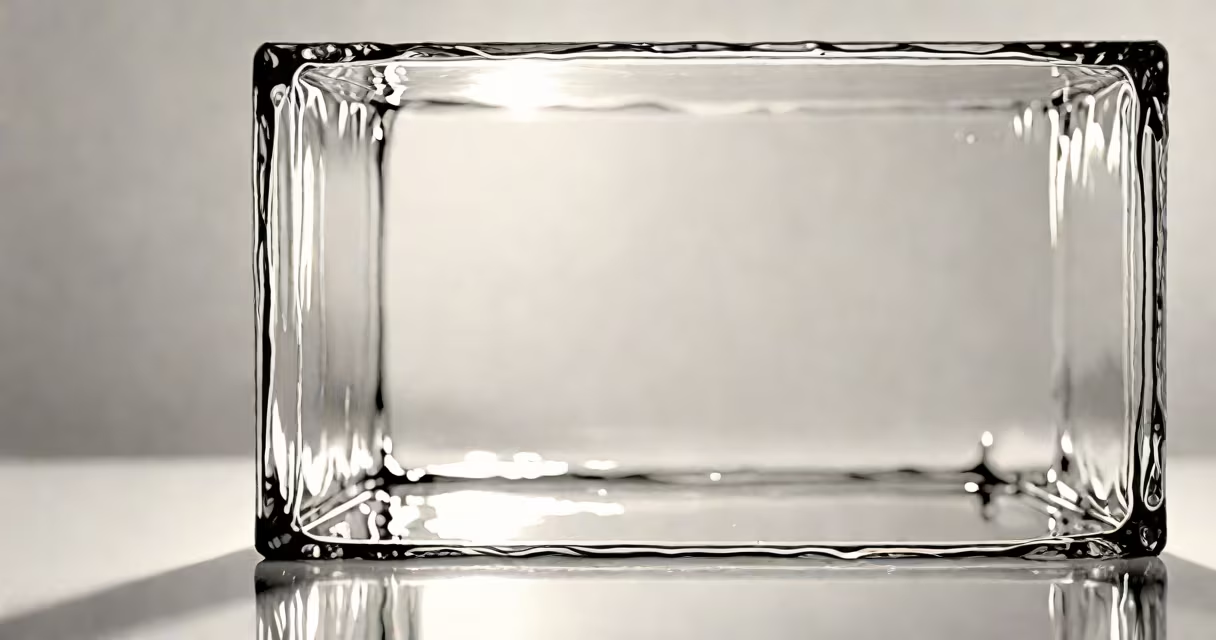
Plain glass is a transparent, amorphous solid formed by rapidly cooling molten silica without allowing atoms to arrange into a crystalline lattice. It lacks long-range order but maintains short-range atomic arrangement, enabling light transmission while resisting fracture under moderate stress.
Plain glass begins as sand-primarily silicon dioxide (SiO₂)-heated to about 1,700°C until it melts. The liquid is then cooled quickly, preventing atoms from settling into a repeating crystal pattern. This rapid quenching traps the disordered atomic structure characteristic of glass. The result is a rigid material that appears solid yet behaves like a liquid over extremely long timescales.
Standard window glass contains additives such as sodium carbonate (Na₂CO₃) and calcium oxide (CaO) to lower melting temperature and improve durability. These components reduce brittleness and improve resistance to thermal shock. Without them, pure SiO₂ would require impractically high temperatures to process.
Plain glass consists mostly of silicon and oxygen atoms linked in a continuous network of SiO₄ tetrahedra. Unlike crystals, where these units align in a repeating grid, glass features a random distribution of bonds. This lack of periodicity prevents light scattering, preserving optical clarity.
Despite its apparent simplicity, this disordered structure gives glass unique mechanical behavior. It fractures suddenly under impact rather than deforming gradually like metals. The absence of slip planes-common in crystalline materials-means dislocations cannot move, limiting plastic deformation.
A key difference between glass and crystalline solids lies in their melting points. Crystals melt sharply at a defined temperature. Glass softens gradually over a wide temperature range, known as the glass transition region. For typical soda-lime glass, this occurs between 500°C and 600°C, depending on heating rate.
While "plain glass" often refers to standard window or container glass, several variants exist based on composition and processing:
| Type | Primary Additives | Use Case | Key Property |
|---|---|---|---|
| Soda-lime glass | Sodium oxide, calcium oxide | Windows, bottles, jars | Low cost, easy to shape |
| Borosilicate glass | Boric oxide (B₂O₃) | Laboratory equipment, cookware | High thermal resistance |
| Lead crystal glass | Lead oxide (PbO) | Decorative items, chandeliers | High refractive index, brilliant sparkle |
Soda-lime glass makes up over 90% of commercial glass production due to low raw material costs and ease of manufacturing. Borosilicate glass, used in Pyrex cookware, resists cracking when exposed to sudden temperature changes-critical for lab flasks and ovenware.
One non-obvious fact: plain glass doesn't degrade in air. Unlike iron, which rusts, or aluminum, which oxidizes visibly, glass forms a passive oxide layer that doesn't alter appearance. Over centuries, however, weathering can occur through interaction with moisture and pollutants, leading to surface etching and reduced clarity.
Many assume plain glass flows slowly over time, causing old windows to appear thicker at the bottom. This myth stems from misinterpretation of historical construction practices. Early glass was hand-blown and uneven, with thicker edges placed downward for stability. Modern analysis confirms no measurable flow in glass over centuries.
Another misconception is that all clear glass is equally strong. In reality, strength varies widely. Annealed glass (standard window glass) withstands about 10 MPa of tensile stress. Tempered glass, heat-treated to induce compressive surface layers, handles up to 100 MPa-making it 10 times stronger and safer when broken.
I once observed a 19th-century church window in England where the lead caming had warped slightly. The glass itself showed no signs of sagging. Cross-referencing archival records confirmed the original installation method involved setting heavier panes at the bottom-not because of flow, but for weight balance.
Consider a residential window measuring 1.2 meters by 1.8 meters. The glass thickness is typically 4 mm for standard applications. Using the modulus of rupture formula for brittle materials:
σ = (3 × F × L) / (2 × w × t²)
Where: - σ = maximum stress (Pa) - F = applied force (N) - L = span length (m) - w = width (m) - t = thickness (m)
If a 5 kg bird hits the center of the window at 10 m/s, the kinetic energy is 250 J. Assuming the impact lasts 0.01 seconds, the average force is 25,000 N. Plugging into the equation:
σ = (3 × 25,000 × 1.8) / (2 × 1.2 × 0.004²) ≈ 112 MPa
This exceeds the tensile strength of annealed glass (around 50 MPa), meaning the window would shatter. However, laminated glass-two sheets bonded with PVB film-can absorb impact energy and hold together, reducing injury risk.
While plain glass is silicate-based, metallic glass shares structural traits. Both lack long-range order and form via rapid cooling. But metallic glass uses metal alloys like palladium-nickel-phosphorus, cooled at rates exceeding 1 million °C per second. Its atomic structure allows higher strength and corrosion resistance than traditional metals.
Unlike silicate glass, metallic glass exhibits ductility under certain conditions. It can bend without fracturing-a property impossible in conventional crystalline metals. Still, it remains brittle at room temperature unless heated above its glass transition point.
Understanding how plain glass functions reveals why it remains central to architecture, optics, and packaging. Its ability to transmit light while maintaining structural integrity stems from controlled disorder at the atomic level-a balance achieved through precise formulation and cooling protocols.