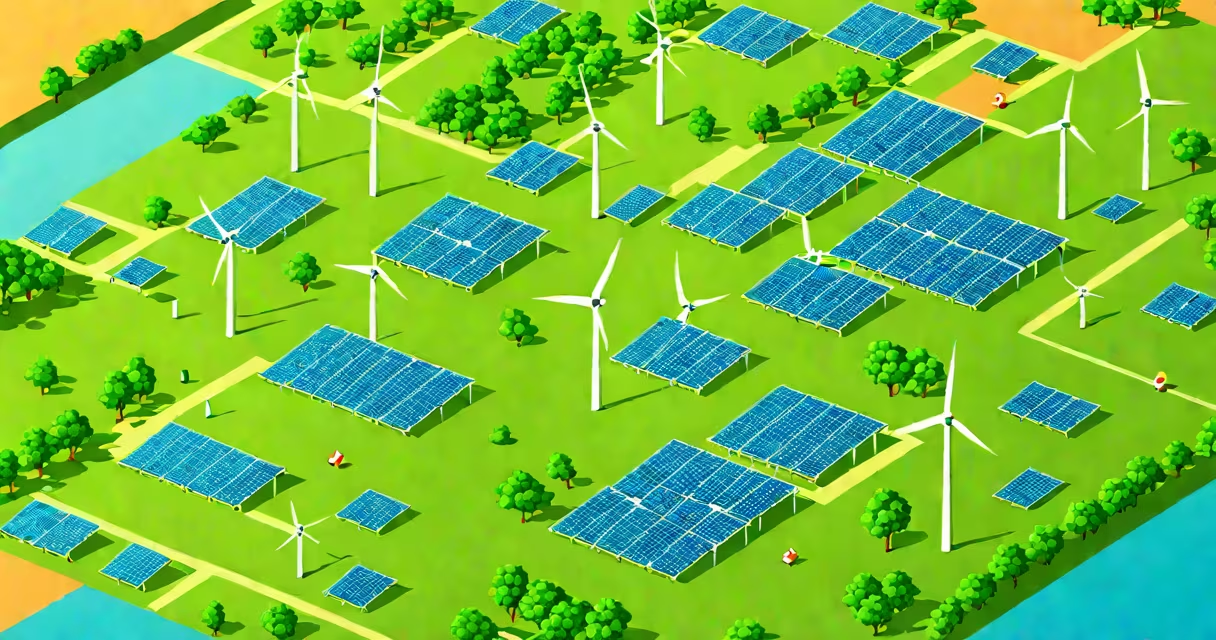
Renewable energy resources generate power from naturally replenishing sources like sunlight, wind, water, and geothermal heat, offering long-term environmental, economic, and energy security benefits compared to fossil fuels.
These resources produce little to no greenhouse gas emissions during operation, reducing air pollution and slowing climate change. They also decrease dependence on imported fuels, stabilize energy prices over time, and create jobs in manufacturing, installation, and maintenance. Unlike finite fossil fuels, they won't run out within human timescales.
Renewable systems convert natural flows into electricity or heat. Solar panels use photovoltaic cells to turn sunlight into direct current electricity. Wind turbines capture kinetic energy from moving air, spinning generators to produce alternating current. Hydropower uses flowing water to turn turbines. Geothermal plants tap underground heat to drive steam turbines.
Each system connects to a grid or powers off-grid homes via batteries. Modern inverters convert DC to AC for household use. Smart meters track energy flow and enable net metering, where excess solar power feeds back into the grid for credit.
The U.S. Department of Energy reports that solar and wind now supply over 20% of U.S. electricity, up from less than 5% in 2010. This growth stems from declining technology costs and policy support.
Four major types dominate global deployment: solar, wind, hydropower, and geothermal. Each offers distinct advantages based on location, infrastructure, and scale.
| Type | Primary Source | Key Advantage | Typical Use Case |
|---|---|---|---|
| Solar | Direct sunlight | Scalable from rooftop panels to utility-scale farms | Residential, commercial, and grid-connected power |
| Wind | Atmospheric wind patterns | High energy yield per turbine in consistent wind zones | Large-scale power generation in plains and offshore areas |
| Hydropower | Flowing rivers or reservoirs | Reliable baseload power with storage via pumped hydro | Nationwide grids, especially in mountainous regions |
| Geothermal | Earth's internal heat | Continuous output regardless of weather or time of day | Local heating and electricity in tectonically active zones |
Not all renewables are equal in land use or ecological impact. For example, large dams disrupt fish migration and alter river ecosystems. Offshore wind farms avoid land use conflicts but face higher installation costs and marine habitat concerns.
Renewables are often seen as unreliable due to intermittency. But grid operators manage variability through forecasting, battery storage, and diversified resource mixes. California's grid, for instance, met 60% of peak demand with solar and wind in 2023, supported by lithium-ion batteries and interregional transmission.
Another myth is that renewables require massive subsidies. The International Energy Agency notes that in 2022, wind and solar received less than 10% of global energy subsidies, while fossil fuels still receive over $700 billion annually in direct and indirect support.
A lesser-known fact: the lifetime carbon footprint of solar panels is about 40 grams CO₂ per kWh-far below coal's 1,000 grams. Even accounting for manufacturing and disposal, solar remains one of the lowest-emission energy sources.
In 2023, Texas installed over 4 gigawatts of new solar capacity, enough to power 1 million homes. A residential homeowner in Austin replaced a 20-year-old gas furnace with a heat pump and added 8 kW of rooftop solar. With state incentives and net metering, the system paid for itself in 7 years.
Over 25 years, the homeowner saved $38,000 in electricity costs and avoided 140 metric tons of CO₂ emissions-equivalent to planting 3,500 trees. The system also reduced strain on the local grid during summer peaks.
This case illustrates how individual adoption contributes to systemic benefits: lower emissions, reduced infrastructure stress, and long-term cost stability.
Climate goals depend on replacing fossil fuels. The Intergovernmental Panel on Climate Change states that limiting warming to 1.5°C requires 70% of global electricity to come from renewables by 2050. Current trends suggest that solar and wind alone could meet 50% of global demand by 2030.
Energy independence is another key outcome. Countries like Denmark and Uruguay now generate over 50% of their electricity from renewables, reducing exposure to volatile oil and gas markets.
For policymakers, the advantages translate into job creation. The U.S. Bureau of Labor Statistics projects a 61% growth in solar installer jobs between 2022 and 2032-faster than average for all occupations.
On a personal level, switching to renewables reduces long-term energy bills. A 2023 study by the National Renewable Energy Laboratory found that households with solar panels saw average annual savings of $1,200, even after loan payments.
Renewable energy resources offer measurable environmental protection, economic resilience, and energy autonomy. Their advantages extend beyond emissions reduction-they provide stable pricing, local job creation, and national security benefits.
Understanding these advantages supports informed decisions in homes, businesses, and public policy. As technology improves and deployment scales, the long-term value of renewable energy becomes increasingly clear.