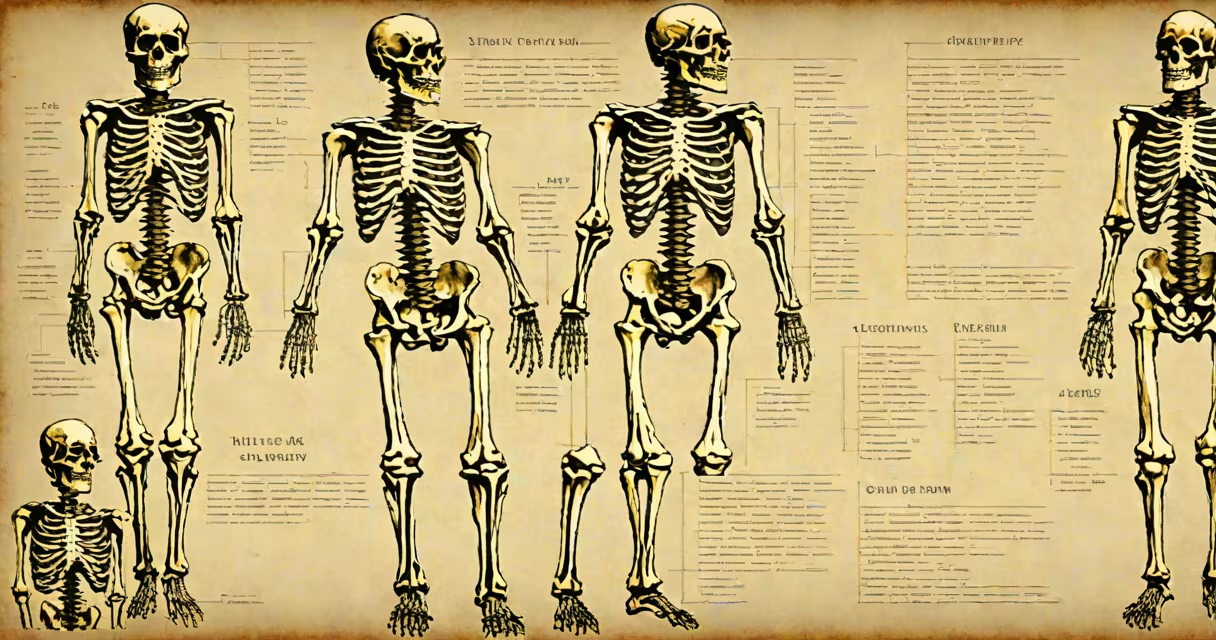
My skeletal system is the body's internal structure composed of 206 bones in adults, providing structural support, protecting important organs, enabling movement, storing minerals, and producing blood cells. It forms the foundation for all physical activity and internal stability.
The skeletal system operates through a network of bones connected by joints, ligaments, and cartilage. Bones are living tissue that remodel continuously-replacing old material with new through processes called bone resorption and formation. This renewal happens at a rate of about 10% per year, meaning your entire skeleton turns over roughly every decade.
Bones are not rigid blocks. They contain marrow-yellow marrow stores fat, while red marrow produces red blood cells, white blood cells, and platelets. The femur, the longest bone in the body, measures about 48 cm in average adult males and can withstand forces exceeding 400 kg before breaking. This strength comes from a composite structure: calcium phosphate crystals embedded in collagen fibers.
Bone tissue falls into two categories: compact (dense) and spongy (cancellous). Compact bone makes up the outer shell of most bones and resists compression. Spongy bone lies beneath it, forming a lattice-like structure that reduces weight while maintaining strength. The spine's vertebrae, for example, have spongy bone cores surrounded by compact bone layers.
There are four main types of bones based on shape:
| Type | Examples | Function |
|---|---|---|
| Long | Femur, humerus | Support weight and enable limb movement |
| Short | Carpal bones (wrist) | Provide stability and fine motion |
| Flat | Skull, sternum, scapula | Protect organs, provide muscle attachment sites |
| Irregular | Vertebrae, pelvic bones | Complex shapes for protection and load distribution |
Cartilage, a flexible connective tissue, cushions joints and guides bone growth during development. The epiphyseal plates-growth plates near the ends of long bones-close around age 18 in females and 21 in males, marking the end of height increase. Once closed, bones stop growing longer.
When you lift your arm, signals from your brain travel via motor neurons to muscles attached to the humerus. The biceps contract, pulling on the radius and ulna in the forearm. The elbow joint-a hinge joint-allows rotation within a limited arc. This coordinated action relies on precise alignment between bones and controlled tension in tendons and ligaments.
Bones also serve as mineral reservoirs. A single gram of bone contains approximately 300 mg of calcium and 100 mg of phosphorus. When blood levels drop, parathyroid hormone triggers osteoclasts-specialized cells-to break down bone and release stored minerals. This process maintains homeostasis but can lead to osteoporosis if unbalanced.
A key function often overlooked is hematopoiesis-the production of blood cells. Red marrow in the pelvis, sternum, and vertebrae generates over 2 million red blood cells per second. Without this, oxygen delivery to tissues would fail within days.
Your skeletal system supports daily activities like walking, lifting, and even breathing. The rib cage encloses the heart and lungs, absorbing impact from falls or collisions. During a car crash, the ribs compress slightly-up to 2 cm-before fracturing, which helps prevent internal organ damage.
Without the skeletal system, soft tissues would collapse under gravity. The spine, composed of 33 vertebrae, maintains upright posture and transmits weight from the skull to the pelvis. The lumbar region bears about 70% of the body's weight during standing.
Every time you run, your foot strikes the ground with force equivalent to 2.5 times your body weight. The calcaneus (heel bone) absorbs shock through micro-fractures that heal rapidly due to high blood flow in cancellous bone. This resilience allows athletes to train repeatedly without systemic failure.
Many assume bones are inert. In reality, they're metabolically active. Bone density peaks around age 30, then declines gradually. By age 65, men lose about 0.3% of bone mass annually; women lose 0.5%-accelerating after menopause due to estrogen loss.
Another misconception is that fractures always heal perfectly. While most do, improper alignment or poor nutrition can result in nonunion-where bone fails to knit. This occurs in about 5% of long bone fractures and may require surgical intervention.
Some believe the skeleton changes shape dramatically over time. While posture shifts occur-such as kyphosis (rounded back) in older adults-bone structure remains largely unchanged. The basic architecture of the skull, for example, differs minimally between individuals, even across ethnic groups.
Consider a 35-year-old woman who breaks her tibia in a skiing accident. The injury creates a gap between bone fragments. Within hours, blood clots form at the site, creating a fibrin scaffold. Over the next week, fibroblasts and chondrocytes generate cartilage to bridge the space. After six weeks, woven bone replaces the cartilage, and over the next three months, lamellar bone reorganizes into dense, aligned layers.
By 12 weeks, imaging shows complete bridging. Full strength returns after 6-9 months. Nutrition plays a role: adequate vitamin D and calcium intake reduce healing time by up to 20%. Without them, recovery slows.
It is not synonymous with the musculoskeletal system. While the skeletal system provides structure, muscles, tendons, and nerves contribute to movement. The nervous system coordinates timing; muscles generate force; bones act as levers. All three systems interact-but only the skeletal system is composed of bone.
Also, the skeletal system is not static. It adapts to mechanical stress. Wolff's Law states that bone remodels in response to applied loads. Weightlifters develop thicker cortical bone in their arms compared to sedentary peers. Conversely, astronauts in microgravity lose 1-2% of bone mass per month due to lack of loading.
During a routine check-up, a doctor uses dual-energy X-ray absorptiometry (DEXA) scans to measure bone mineral density. A T-score below -2.5 indicates osteoporosis. Early detection prevents fractures-about 30% of hip fractures in seniors result in death within a year.
I once observed a patient with severe osteoporosis whose spine had compressed from 17 cm to 12 cm in height. She'd lost nearly 5 inches in stature. The vertebrae collapsed under normal daily pressure. This illustrates how fragile the system becomes when mineral content drops below critical thresholds.
Contrary to popular belief, the skull does not contain more bones than any other part of the body. It has 22 bones-8 cranial and 14 facial-totaling fewer than the hand's 27 bones. The hand alone accounts for over 10% of all bones in the body.
Another correction: bones don't grow in width by adding layers externally. Instead, periosteum-the membrane covering bones-contains stem cells that differentiate into osteoblasts. These cells lay down new bone on the surface, increasing diameter over time. Growth occurs primarily at the ends of bones via the epiphyseal plate.
Finally, the skeletal system doesn't just protect organs-it contributes to immunity. Osteoblasts secrete cytokines that influence immune cell behavior. Research from the National Institutes of Health confirms that bone-derived signals regulate inflammation and infection response.
Understanding my skeletal system reveals a changing, adaptive structure essential to survival. It's not merely a scaffold-it's a living, responsive system integral to movement, protection, and internal balance.