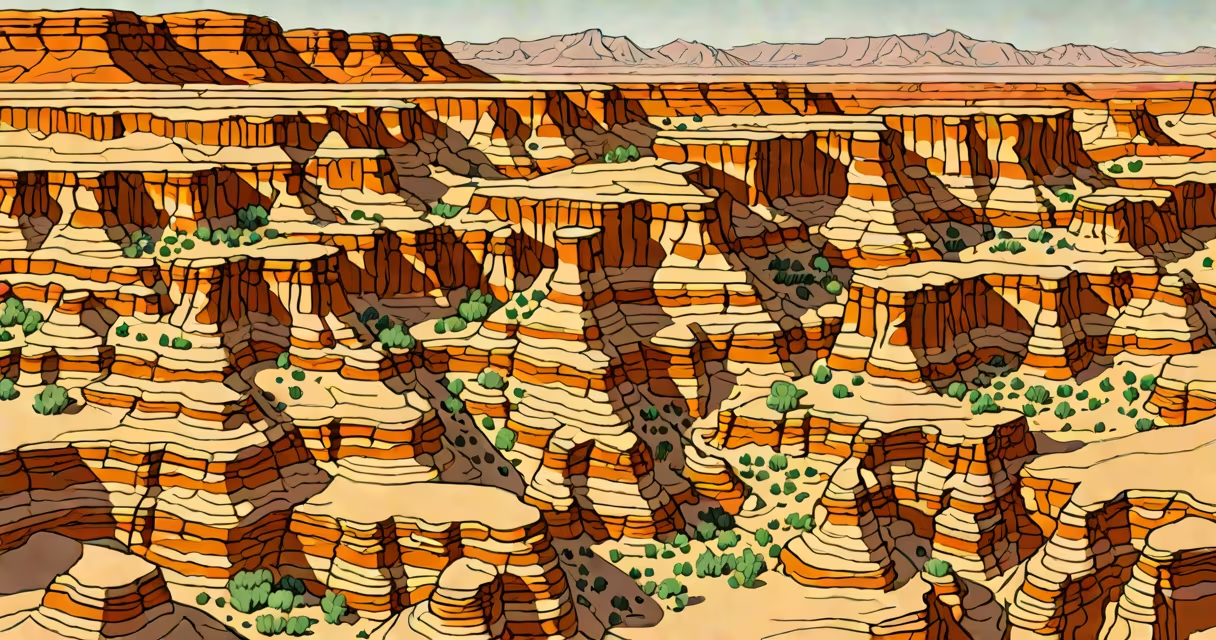
Sedimentary rocks form when mineral or organic particles settle, compact, and cement together over time, creating layered structures that record Earth's environmental history. These rocks make up about 75% of the Earth's surface exposed bedrock and preserve fossils, climate records, and ancient landscapes.
They originate through weathering, erosion, transport, deposition, compaction, and cementation-processes that move material from one place to another and bind it into solid rock. Unlike igneous or metamorphic rocks, which form from heat and pressure, sedimentary rocks grow slowly, often over thousands to millions of years, in environments like riverbeds, lakes, oceans, and deserts.
The U.S. Geological Survey defines sedimentary rocks as "products of the accumulation and lithification of loose sediments." Lithification-the process of turning loose grains into solid rock-occurs when water or minerals seep between particles and harden them together. This transformation turns sand into sandstone, clay into shale, and calcium-rich shells into limestone.
Formation begins with weathering, where existing rocks break down into smaller pieces due to wind, water, ice, or chemical reactions. Erosion then moves these fragments via gravity, rivers, glaciers, or wind. Once transported, they settle in low-energy environments such as lake bottoms, ocean floors, or floodplains.
Deposition creates layers called strata. As more material accumulates, the weight compresses lower layers. Water trapped between grains gets squeezed out, reducing pore space. Minerals dissolved in groundwater-like calcite, quartz, or iron oxides-then precipitate into the spaces, binding particles into a solid mass. This final stage is cementation.
A real-world example: the Grand Canyon exposes nearly 400 million years of sedimentary layering. The Coconino Sandstone, a prominent white layer, formed from ancient desert dunes deposited 270 million years ago. Wind-blown sand accumulated in shifting dunes, later buried and cemented by calcite-rich groundwater.
Sedimentary rocks fall into three main categories based on origin: clastic, chemical, and organic.
| Type | Source Material | Common Examples | Forming Environment |
|---|---|---|---|
| Clastic | Weathered fragments of other rocks | Sandstone, shale, conglomerate | Rivers, deltas, beaches |
| Chemical | Ions precipitated from water | Limestone, rock salt, gypsum | Shallow seas, evaporating lakes |
| Organic | Remains of plants or animals | Coal, some limestones | Swamps, ocean floors |
Clastic rocks are classified by grain size. Sandstone contains particles between 0.0625 mm and 2 mm. Shale forms from clay-sized particles (<0.0039 mm), which compact tightly into thin, fissile layers. Conglomerate features rounded pebbles bound in finer matrix-indicating high-energy flow like mountain streams.
Chemical sedimentary rocks form when dissolved ions crystallize. For example, limestone (CaCO₃) builds from shell fragments and calcium carbonate precipitation in warm, shallow seas. Rock salt (halite) forms when seawater evaporates in arid basins-such as the Dead Sea or modern salt flats in Utah.
Organic sedimentary rocks come from biological activity. Coal forms from compressed plant matter in swamps over tens of millions of years. Peat, the initial stage, becomes lignite, then bituminous coal under heat and pressure. The Powder River Basin in Wyoming holds vast coal deposits formed during the Paleocene-Eocene epochs.
Sedimentary rocks dominate continental surfaces. The North American continent, for instance, has extensive sedimentary sequences beneath the Great Plains and in the Appalachian Mountains. These layers reveal past sea levels, climates, and life forms.
Fossils are preserved in sedimentary rock because the slow, quiet deposition allows delicate remains to avoid destruction. Dinosaur bones, ammonite shells, and early human footprints have survived in sedimentary layers worldwide. The Burgess Shale in Canada, dating to 508 million years ago, preserves soft-bodied organisms rarely fossilized elsewhere.
These rocks also host natural resources. Oil and gas form when organic-rich shales are buried and heated over time. Porous sandstones trap hydrocarbons underground. The Permian Basin in Texas and New Mexico contains oil-bearing sandstone reservoirs that have produced over 30 billion barrels since the 1920s.
One common misconception is that all sedimentary rocks are soft or crumbly. While many, like shale, fracture easily, others like sandstone and limestone can be extremely durable. The Sphinx in Egypt is carved from limestone-a sedimentary rock resistant enough to endure millennia of desert winds.
Sedimentary rocks are not the same as sediment. Sediment is loose material-sand, silt, clay-before it becomes rock. Only after compaction and cementation does it qualify as sedimentary rock. Confusing the two leads to errors in geological interpretation.
They also differ from igneous rocks, which cool from molten magma. Granite, basalt, and obsidian form from volcanic or plutonic processes-not from particle accumulation. Metamorphic rocks, like marble or slate, result from heat and pressure altering existing rock-again, not from deposition.
During fieldwork in Nevada's Black Rock Desert, I observed cross-bedding in sandstone-rhythmic inclined layers formed by wind or water currents. That structure confirmed the rock's origin in a changing environment, not a calm lake. Cross-bedding is a diagnostic feature absent in igneous or metamorphic rocks.
Understanding the sedimentary rocks definition clarifies how Earth's surface evolves. It explains why certain areas contain oil, why fossils appear in specific layers, and how past climates shaped current landscapes. The process is slow, but the results are visible across continents.