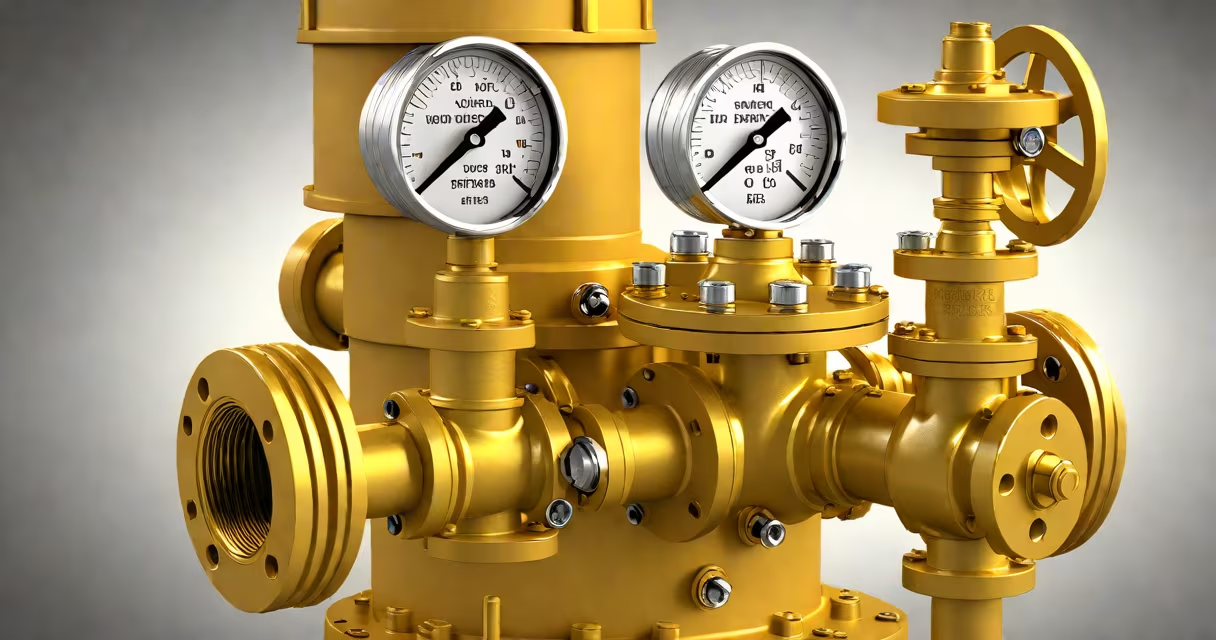
A safety valve is a mechanical device designed to automatically release excess pressure from a closed system to prevent catastrophic failure. It activates when pressure exceeds a preset limit, protecting equipment, personnel, and facilities.
Safety valves operate on a simple principle: they remain sealed under normal operating conditions. When internal pressure rises above a safe threshold-typically set during design-they open abruptly to vent pressure. Once pressure drops below the threshold, the valve closes again. This action prevents overpressure events that could lead to ruptures, fires, or explosions.
The American Society of Mechanical Engineers (ASME) sets standards for safety valve performance in high-pressure systems. According to ASME Boiler and Pressure Vessel Code (BPVC), Section VIII, safety valves must relieve pressure within specified timeframes and maintain tight sealing when closed. These requirements ensure reliability under extreme conditions.
Most safety valves function using a spring-loaded mechanism. A compressed spring holds the valve disc against the seat. As pressure builds inside the vessel, it exerts force on the disc. When this force exceeds the spring's preload, the disc lifts, creating a gap for fluid or gas to escape.
Some valves use pilot-operated designs, where a small secondary valve controls the main valve's opening. Pilot valves respond to pressure changes and modulate the main valve's actuation. These are common in large-scale industrial systems where precise control and minimal leakage are required.
For example, in a natural gas pipeline, a safety valve rated at 150 psi will open if pressure reaches 160 psi. The release flow rate is calculated based on the pipe diameter, fluid density, and valve orifice size. A 2-inch safety valve can discharge up to 1,200 cubic feet per minute of gas, depending on the medium and pressure differential.
Valves are categorized by their operation method, application, and design. The most common types include:
| Type | Operation Mechanism | Typical Use Case | Key Limitation |
|---|---|---|---|
| Spring-loaded | Compression spring holds disc closed | Boilers, compressors, HVAC systems | Less responsive to slow pressure increases |
| Pilot-operated | Small valve controls main valve via pressure signal | High-flow pipelines, refineries | Requires external power source for pilot |
| Weight-loaded | Mass counterbalances pressure | Historical steam engines, low-pressure systems | Not suitable for changing environments |
Spring-loaded valves dominate industrial applications due to their simplicity and reliability. They are tested annually under pressure to verify set-point accuracy. Pilot-operated valves offer higher precision and lower blowdown (the pressure drop needed to reseat the valve), making them ideal for systems sensitive to pressure fluctuations.
Many people mistake safety valves for pressure regulators. While both manage pressure, their functions differ. A regulator maintains a constant downstream pressure. A safety valve only opens when pressure exceeds a maximum limit and remains closed otherwise.
Another confusion arises with relief valves. Though often used interchangeably, relief valves are designed for liquid service and typically open gradually. Safety valves are engineered for rapid, full-opening in vapor or gas systems. Using a relief valve in a high-pressure gas line risks delayed response and inadequate discharge capacity.
One non-obvious distinction: safety valves are not meant to be manually operated. Their automatic function is critical. Forcing a valve open during normal operation can damage the seal or cause premature wear. Maintenance involves inspection, cleaning, and recalibration-not manual override.
In a chemical processing plant, a reactor vessel operates at 200 psi. The safety valve is set to activate at 220 psi. During a process upset, the temperature rises, increasing internal pressure. When pressure hits 225 psi, the valve opens instantly, releasing vapor through a flare stack. The system pressure drops to 205 psi within 1.5 seconds. The valve reseals automatically, preventing further loss.
This event prevented a potential rupture. The plant's safety audit later confirmed the valve had been properly maintained and met ASME requirements. Had the valve failed, the resulting explosion could have breached containment walls and endangered adjacent units.
I once observed a safety valve fail during a routine test at a water treatment facility. The valve did not open despite exceeding the set pressure. Investigation revealed corrosion on the disc seating surface. After cleaning and replacing seals, the valve passed retesting. This incident highlighted that even well-maintained valves require periodic functional checks-not just visual inspections.
Pressure systems without safety valves risk severe consequences. The 1984 Bhopal disaster, caused by uncontrolled release of methyl isocyanate, was exacerbated by missing or malfunctioning pressure relief devices. Modern regulations now mandate safety valves on all pressurized vessels handling hazardous materials.
Regulatory bodies such as OSHA and the EPA enforce compliance. OSHA Standard 1910.119 requires employers to install pressure relief devices on equipment handling flammable or toxic substances. Failure to comply can result in fines up to $136,532 per violation.
Understanding the safety valve meaning is essential for engineers, operators, and maintenance staff. It's not just about mechanical function-it's about responsibility. A single valve can prevent loss of life, environmental damage, and multi-million-dollar asset loss.