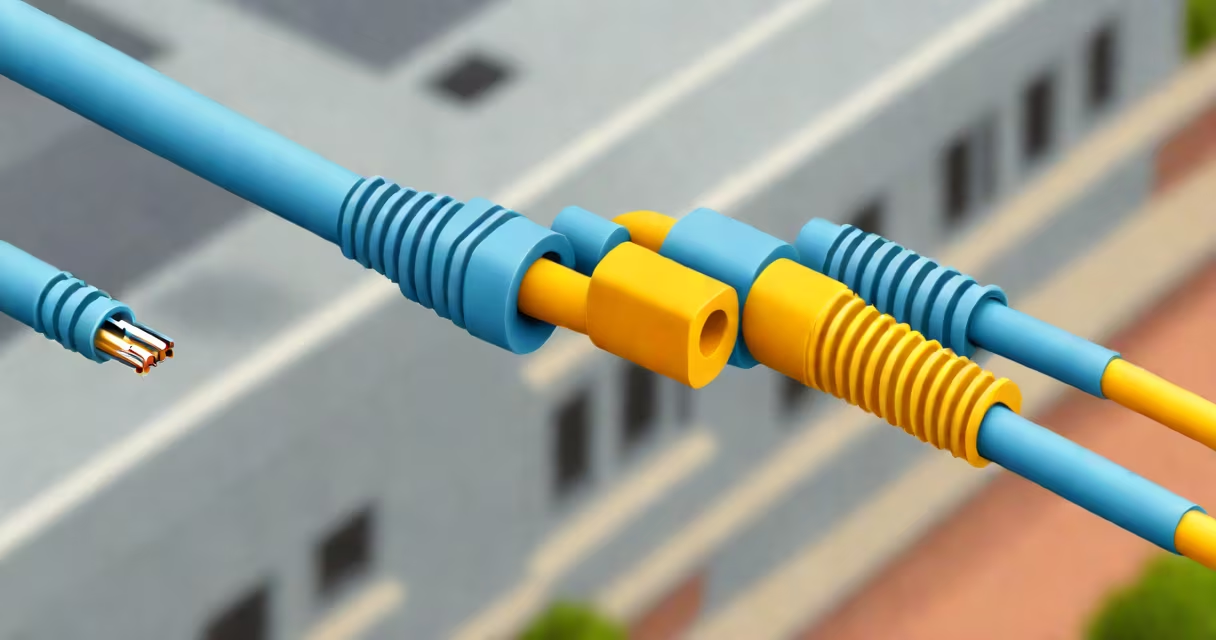
A weatherproof network cable is a shielded Ethernet cable engineered to maintain reliable data transmission in outdoor or harsh environments, featuring UV-resistant jackets, waterproof connectors, and protection against moisture, temperature swings, and physical stress.
These cables differ from standard indoor Ethernet cables by using materials and construction methods that resist degradation from sunlight, rain, snow, and extreme temperatures. They're commonly used in security camera systems, industrial monitoring, outdoor Wi-Fi access points, and remote sensor networks where exposure to the elements is unavoidable.
Unlike standard Cat5e or Cat6 cables, which degrade quickly when exposed to sunlight and water, weatherproof network cables use polyethylene or PVC jackets with UV stabilizers and sealed connectors. The shielding prevents electromagnetic interference, ensuring consistent signal integrity even over long runs in open fields or along building exteriors.
They function like standard twisted-pair Ethernet cables but with added environmental protection. Data travels through eight copper wires arranged in four twisted pairs, reducing crosstalk and maintaining bandwidth up to 1 Gbps or higher depending on category rating.
The key difference lies in the outer sheath and connector design. The jacket is thick, flexible, and formulated to resist cracking under freezing conditions or softening in high heat. Connectors are often hermetically sealed with rubber gaskets or epoxy resin to prevent water ingress.
For example, a Cat6-rated weatherproof cable can support 10 Gbps speeds over 55 meters. When deployed between a surveillance camera and a network video recorder (NVR) mounted on a metal pole in a coastal area, it withstands salt spray and daily humidity cycles without signal loss.
Weatherproof network cables come in several variants based on application, environment, and performance needs. The most common types are:
| Type | Use Case | IP Rating | Typical Jacket Material | Max Run Length |
|---|---|---|---|---|
| Indoor/Outdoor Hybrid | Running from inside a building to an exterior wall | IP67 | PVC with UV inhibitor | 100 m |
| Full Outdoor | Exposed to direct rain, snow, or desert heat | IP68 | Low-density polyethylene (LDPE) | 100 m |
| Armored | High-risk areas with rodents or heavy foot traffic | IP68 | Steel braid + LDPE | 75 m |
IP ratings indicate protection levels. An IP68 rating means dust-tight and submersible in water up to 1.5 meters for 30 minutes. This level is required for permanent installations near pools, docks, or in agricultural settings.
Some models include drain wires-small conductive strands that channel water away from the cable core during freeze-thaw cycles. Without them, trapped moisture can expand and damage internal insulation.
Weatherproof network cables are essential in applications where reliability cannot be compromised by environmental factors. A single failure in a security system due to water-damaged wiring can result in lost footage or delayed response during emergencies.
For instance, a university campus in northern Minnesota uses weatherproof Cat6 cables to connect outdoor motion sensors and emergency call boxes along walking paths. These cables survive -30°C winters and frequent thaw cycles without signal degradation.
Another example: a vineyard in Napa Valley uses weatherproof cables to link soil moisture sensors and automated irrigation controllers. The system operates year-round, adjusting water delivery based on real-time data, even during monsoon season.
Many assume that sealing a standard indoor Ethernet cable with silicone or tape makes it weatherproof. This is incorrect. Indoor cables lack UV-stabilized jackets and have unsealed connectors. Over time, sunlight degrades the jacket, causing cracks and water entry.
Also, people often confuse "waterproof" with "moisture-resistant." Waterproof implies complete exclusion of liquid under pressure. Moisture-resistant only means tolerance to humidity or brief exposure. A cable labeled "waterproof" must meet IP68 standards per IEC 60529.
One non-obvious fact: the bend radius of weatherproof cables is tighter than standard outdoor cables. Because they use flexible polymers, they can be routed around corners without damaging the internal conductors. However, exceeding the minimum bend radius (usually 8× the cable diameter) causes microfractures in the copper, leading to intermittent connectivity.
I once installed a weatherproof network cable to connect a solar-powered weather station to a home server. The site was on a hilltop with strong winds and seasonal ice buildup. After six months, the cable remained functional despite multiple storms. A colleague had previously tried a standard Cat6 cable in the same location-it failed after three weeks due to moisture seepage at the RJ45 connector.
While weatherproof network cables are designed for continuous outdoor deployment, other products serve different purposes:
When selecting a weatherproof network cable, always check the manufacturer's specifications for operating temperature range, maximum pull tension, and compliance with industry standards such as IEEE 802.3 for Ethernet and UL 1581 for wire safety.
For example, a cable rated for -40°C to +75°C can operate reliably in arid deserts and Arctic research stations alike. The National Institute of Standards and Technology (NIST) confirms that proper material selection reduces field failure rates by over 80% compared to non-rated alternatives.
Always test the connection after installation. Use a cable tester like the Fluke Networks DSX-5000 to verify continuity, crosstalk, and signal attenuation. A properly installed weatherproof network cable should show less than 1 dB of loss per 100 meters at 100 MHz.
Weatherproof network cables are not just a convenience-they are a necessity for any outdoor network infrastructure. Their durability, performance, and compliance with environmental standards make them the only viable option for mission-critical deployments in exposed locations.
Understanding the differences between standard and weatherproof variants ensures long-term reliability and avoids costly repairs. Whether securing a remote office or monitoring a wildlife reserve, choosing the right cable prevents downtime and protects investment.