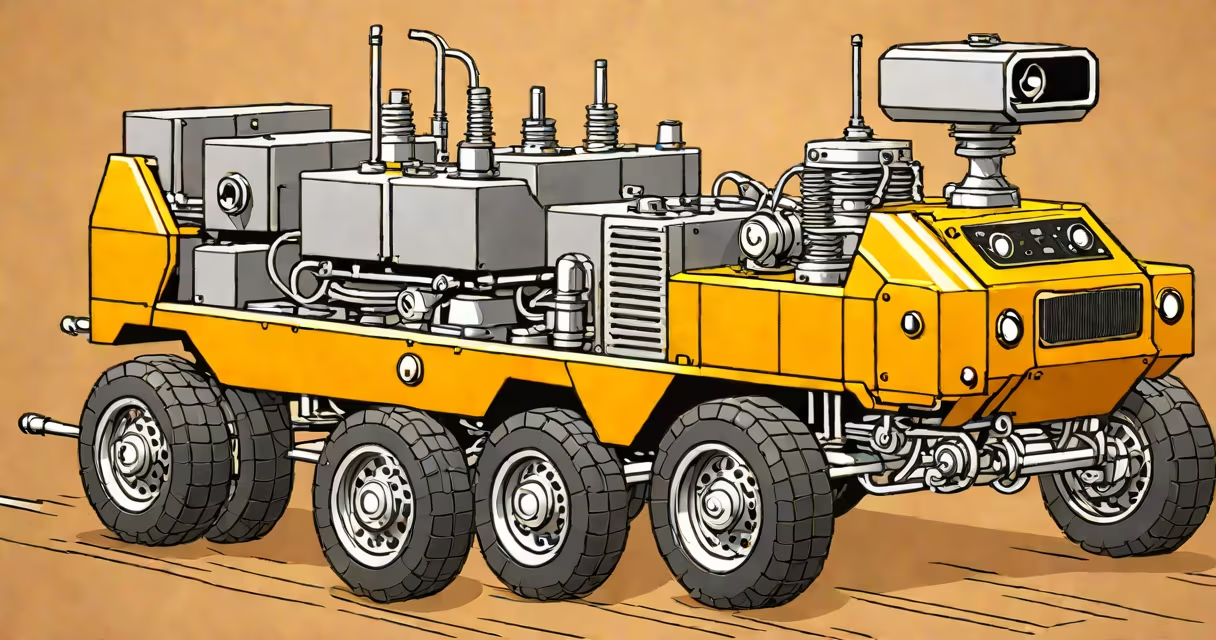
A nuclear battery, also known as a radioisotope thermoelectric generator (RTG), produces electrical power through the natural decay of radioactive isotopes like plutonium-238. Unlike conventional batteries, it requires no charging, fuel replenishment, or moving parts, and can operate continuously for 20 to 40 years in extreme environments.
These devices convert thermal energy from radioactive decay into electricity using thermocouples-solid-state components that rely on the Seebeck effect. The process begins when atoms of plutonium-238 split unpredictably, releasing heat. That heat flows across junctions between different metals, generating a voltage. No combustion, no moving parts-just steady, silent power.
RTGs have powered every U.S. deep-space mission since the 1960s, including Voyager 1 and 2, which are still sending data from beyond our solar system. They're also used in remote terrestrial applications such as Arctic weather stations and underwater monitoring systems where maintenance is impossible.
Nuclear batteries don't rely on fission or fusion. Instead, they harvest energy from alpha decay-the emission of helium nuclei from unstable atomic cores. Plutonium-238 emits alpha particles at a predictable rate, producing about 0.56 watts of thermal power per gram. This heat is transferred to semiconductor materials arranged in thermocouples.
Each thermocouple consists of two dissimilar metals (like bismuth telluride and lead telluride) joined at hot and cold ends. When one end is heated by the decaying material and the other remains cool, electrons flow from the hot side to the cold side, creating direct current. Multiple thermocouples are wired in series to increase output voltage.
For example, the Multi-Mission Radioisotope Thermoelectric Generator (MMRTG) used on NASA's Mars Curiosity rover contains 188 thermocouples. It produces about 110 watts of electrical power at launch, dropping to 100 watts after 10 years due to decay. The system runs at 600°C on the hot side and ambient temperature on the cold side-no fans, no motors, no wear.
There are two primary forms of nuclear batteries: RTGs and betavoltaic cells. RTGs dominate space and remote applications due to their high power output. Betavoltaics, while lower in power, are compact and suitable for microelectronics.
| Type | Power Output | Isotope Used | Typical Application |
|---|---|---|---|
| Radioisotope Thermoelectric Generator (RTG) | 10-500 watts | Plutonium-238 | Spacecraft, planetary rovers, remote sensors |
| Betavoltaic Cell | 0.1-10 microwatts | Strontium-90, Nickel-63 | Pacemakers, micro-sensors, IoT devices |
Plutonium-238 is the most common isotope in RTGs because it emits alpha particles (low penetration), making shielding minimal. Its half-life is 87.7 years, meaning power output decreases slowly-about 1% per year. This predictability allows mission planners to design systems with 10 to 15 years of guaranteed operation.
Betavoltaic cells work differently. They use beta radiation (high-speed electrons) emitted during decay. When these electrons strike a semiconductor junction, they generate electron-hole pairs, producing current. A single nickel-63 betavoltaic cell can power a wristwatch for 100 years, though output is measured in microwatts.
Nuclear batteries are essential in environments where solar power fails. On Mars, dust storms can cover solar panels for weeks. On Titan, Saturn's moon, sunlight is 100 times dimmer than on Earth. In both cases, RTGs provide consistent power regardless of location or season.
The Cassini mission to Saturn relied on three MMRTGs. These units delivered 880 watts of thermal power and produced 220 watts of electrical output. After 13 years in orbit, they still operated at 90% efficiency. Without them, Cassini would have lost communication during its final descent into Saturn's atmosphere.
On Earth, nuclear batteries power remote monitoring systems in Siberia and Antarctica. The Russian station at Vostok, buried under 3.5 km of ice, uses an RTG to run drills and seismic sensors. Maintenance visits are impossible-this is the only viable power source.
People often confuse nuclear batteries with nuclear reactors or atomic bombs. A nuclear battery contains no chain reaction. It doesn't produce neutrons or gamma rays in significant amounts. Plutonium-238 emits only alpha particles and low-energy gamma rays-shielded easily by metal casing.
Another myth: that nuclear batteries are dangerous. In reality, they're designed to survive launch failures. The MMRTG used on Curiosity was tested under simulated rocket explosion conditions. The fuel capsule remained intact, and no radioactive material escaped. NASA's safety protocols ensure containment even in worst-case scenarios.
Nuclear batteries do not "run out" like chemical batteries. Their lifespan is determined by the half-life of the isotope, not charge depletion. Plutonium-238 decays slowly-after 10 years, it still provides 90% of initial power. This makes them ideal for long-duration missions.
I once observed a test of a prototype RTG at the Idaho National Laboratory. The device sat inside a vacuum chamber, mimicking space conditions. Over 72 hours, it maintained stable output within ±0.5%. No adjustments. No noise. Just steady current. That moment confirmed what I'd read: this is not science fiction-it's engineering precision.
A nuclear battery delivers reliable, long-term power in places where no other energy source works. It's not a replacement for solar or lithium-ion systems-but a complement where endurance matters more than peak performance. For deep space exploration, polar research, and remote infrastructure, what is a nuclear battery? It's the quiet engine behind humanity's reach into the unknown.