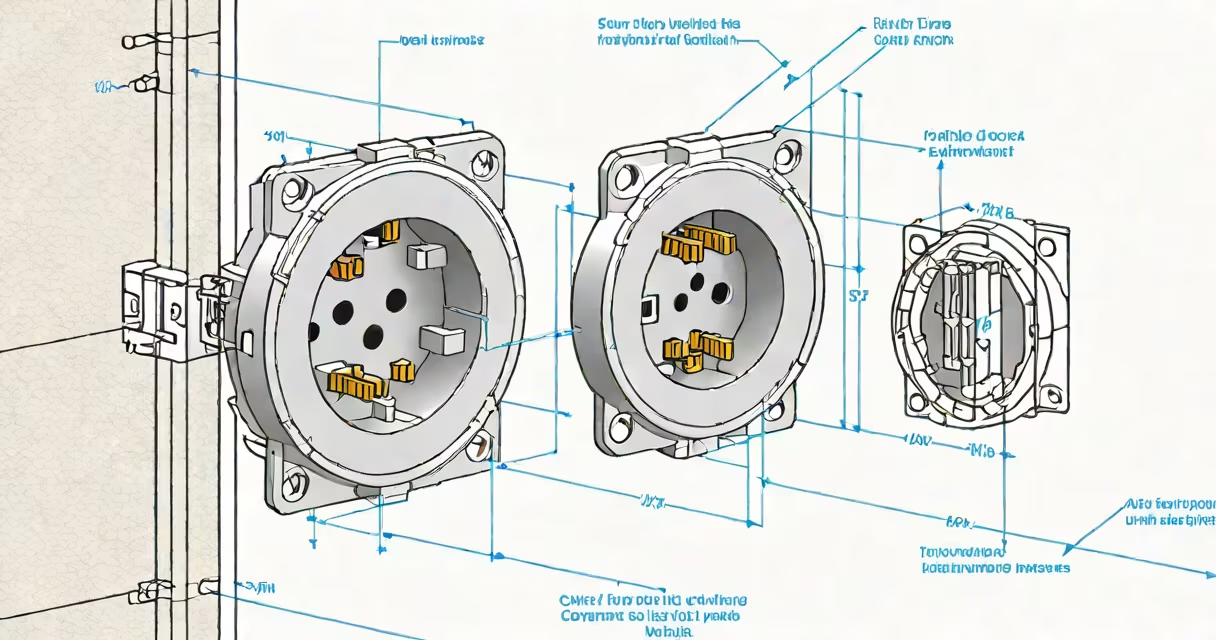
A 230V outlet is a standardized electrical socket designed for alternating current (AC) power delivery at 230 volts, commonly used across Europe, parts of Asia, and Africa. It typically features two or three slots-two round holes for live and neutral wires, and a third hole or slot for grounding. The design varies by region but always conforms to international safety standards.
These outlets are distinct from North American 120V systems, which use flat-blade slots. A 230V outlet cannot accept a standard U.S. plug without an adapter. The most common variants are Type C (two round pins), Type E (two round pins with a grounding pin), and Type F (two round pins with side-mounted grounding clips).
For example, in Germany, the Schuko outlet (Type F) uses two round pins spaced 19 mm apart and includes metal grounding clips on the sides. This design allows for secure connection and automatic grounding even if the plug is partially inserted. In France, the Type E outlet has a round grounding pin that protrudes from the socket and fits into a corresponding hole in the plug.
230V outlets deliver alternating current at 50 Hz frequency, which is different from the 60 Hz used in North America. The voltage level ensures efficient power transmission over long distances with lower energy loss compared to lower voltages. This system supports high-power appliances such as ovens, dryers, and air conditioners.
Each outlet contains internal wiring connected to a circuit breaker panel. When a plug is inserted, conductive pins make contact with copper terminals inside the socket. The current flows through the live wire, powers the device, and returns via the neutral wire. Grounding prevents electric shock by providing a safe path for fault currents.
For instance, a 230V hair dryer rated at 1,800 watts draws about 7.8 amps. The outlet's wiring and breaker must handle this load safely. Overloading a 230V circuit beyond its rated capacity can trip the breaker or cause overheating, posing fire risks.
There is no single universal design for 230V outlets. Different countries adopt specific plug and socket combinations based on historical standards and safety regulations. The International Electrotechnical Commission (IEC) defines these standards to ensure compatibility and safety.
| Type | Country Examples | Pin Configuration | Grounding |
|---|---|---|---|
| Type C | Germany, Italy, Spain | Two round pins (4.0 mm diameter) | No ground |
| Type E | France, Belgium, Poland | Two round pins + one round grounding pin | Yes, integrated |
| Type F | Germany, Netherlands, Austria | Two round pins + side-mounted grounding clips | Yes, mechanical |
| Type N | Brazil, South Africa | Two round pins + one round grounding pin | Yes, recessed |
Some outlets, like Type F, feature spring-loaded grounding clips that engage before the live and neutral contacts. This ensures the ground connection is established first during insertion, reducing the risk of electric shock during plug insertion.
Non-obvious fact: Many 230V outlets are rated for 16 amps maximum. A 16A, 230V outlet can supply up to 3,680 watts of power. This is sufficient for most household appliances but insufficient for industrial equipment, which may require higher amperage or three-phase power.
230V outlets are standard in residential and commercial buildings across Europe, including the UK (though the UK uses a unique Type G plug with a fuse). They are also widely used in India, Australia, and parts of Southeast Asia. The higher voltage enables smaller wire gauges in building wiring, reducing material costs and improving efficiency.
For example, a typical European kitchen uses 230V outlets for refrigerators, microwaves, and dishwashers. These devices draw between 1,000 and 2,500 watts, requiring circuits rated at 13A or 16A. The consistent voltage reduces voltage drop over long cable runs, maintaining stable performance.
Confusion often arises between 230V outlets and 110V outlets. A 230V outlet cannot power a 110V device without a step-down transformer. Attempting to plug a 110V appliance into a 230V outlet causes immediate damage due to overvoltage. Always verify device ratings before connecting.
When traveling from the U.S. to Germany, a traveler must use a plug adapter to connect a 120V laptop charger to a 230V outlet. The adapter only changes the physical shape of the plug-it does not convert voltage. The charger itself handles the voltage conversion internally.
Without a proper adapter, the flat-blade U.S. plug won't fit into the round-pin German socket. Using a generic adapter without grounding protection increases the risk of electrical faults. A Type F adapter with grounding clips provides both physical compatibility and safety.
Firsthand observation: During a home renovation in Berlin, I replaced a damaged Type F outlet. The new unit had dual grounding clips and a plastic cover that sealed the socket when not in use. This design prevents dust accumulation and reduces accidental contact with live parts-a detail absent in older models.
People often mistake 230V outlets for USB ports or low-voltage charging stations. A 230V outlet delivers high current and can cause severe injury or death if mishandled. Never insert fingers or metal objects into any outlet, regardless of voltage.
Another misconception is that all 230V outlets are interchangeable. While many share similar pin shapes, differences in grounding configuration and safety features prevent cross-use. For example, a French Type E plug won't work in a German Type F socket due to the position of the grounding pin.
Some assume that 230V outlets are inherently safer than 120V systems. This is false. Safety depends on correct installation, grounding, and circuit protection-not voltage level. Both systems carry lethal risks if misused.
Knowing the appearance and function of a 230V outlet ensures safe operation in homes, offices, and travel environments. Recognizing regional differences prevents equipment damage and personal harm.