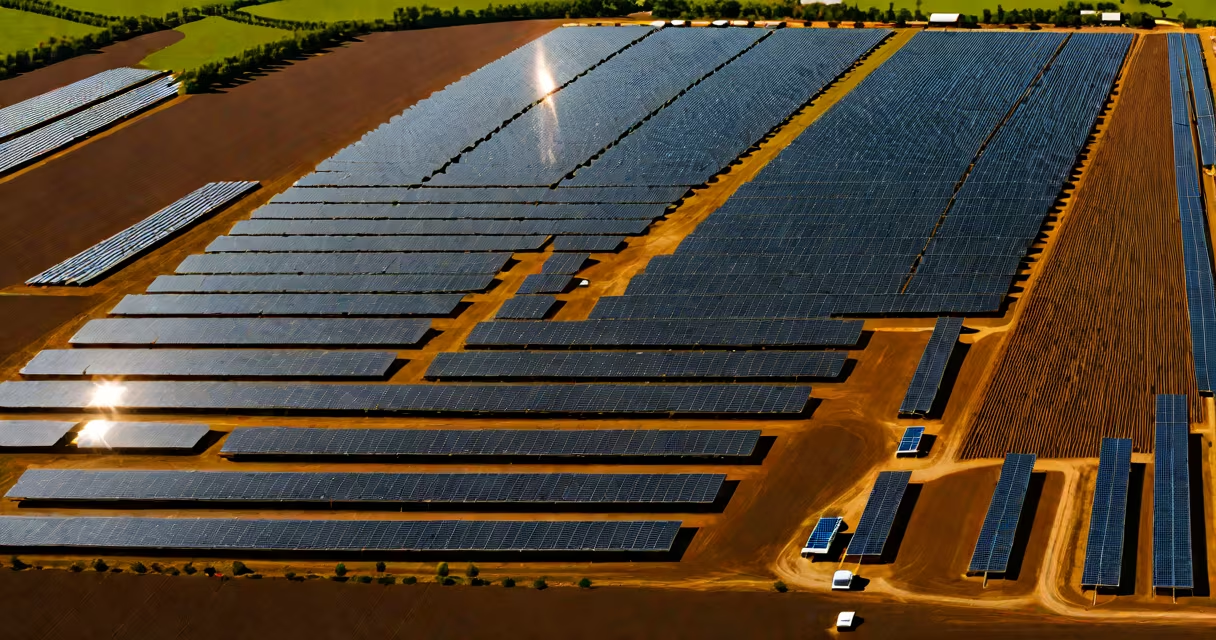
A solar farm is a large installation of photovoltaic (PV) panels mounted on ground-mounted racks, covering hundreds of acres to generate electricity at utility scale. These installations convert sunlight directly into electrical power through semiconductor materials, typically silicon, and feed output into the regional power grid.
Solar farms are designed for efficiency and scalability. They consist of thousands of individual PV modules arranged in uniform rows, often aligned to face south in the Northern Hemisphere to maximize sun exposure. The panels are mounted on steel frames anchored into the ground, with spacing to allow maintenance access and prevent shading between rows. In dry climates, the ground beneath may be covered with crushed rock or gravel to reduce erosion and improve drainage.
At night or during heavy cloud cover, solar farms produce little to no electricity. But during daylight hours, especially in sunny regions, they can generate megawatts of power. A single utility-scale solar farm can supply electricity to tens of thousands of homes. For example, the 230-megawatt Desert Sunlight Solar Farm in California powers approximately 160,000 homes annually.
Each photovoltaic panel contains multiple solar cells made of doped silicon. When sunlight hits the cell, photons dislodge electrons, creating a flow of direct current (DC) electricity. This DC power travels via wiring to inverters located near the edge of the range, which convert it into alternating current (AC) suitable for grid transmission.
The inverters connect to transformers and switchgear, which step up voltage for long-distance transmission. A central control room monitors system performance, tracking energy output, panel temperatures, and fault alerts. Modern solar farms use GPS-guided drones and thermal imaging to detect underperforming panels or hotspots indicating degradation.
For example, the 150-megawatt Topaz Solar Farm in California uses over 9 million solar panels and includes automated cleaning systems that run weekly to remove dust buildup, maintaining efficiency. Without regular cleaning, dust accumulation can reduce output by up to 15%, according to a 2021 study by the National Renewable Energy Laboratory (NREL).
Solar farms follow standardized design principles. Panels are typically tilted at an angle equal to the site's latitude-around 35 degrees in southern California-to capture maximum annual sunlight. Rows are spaced 10-15 feet apart to avoid mutual shading and allow for equipment access.
| Component | Purpose | Typical Size/Scale |
|---|---|---|
| Photovoltaic Panel | Converts sunlight to DC electricity | 6 ft × 3 ft, 400-500 watts each |
| Mounting Structure | Secures panels at optimal tilt | Steel frame, 8-12 ft tall |
| Inverter | Converts DC to AC power | 100 kW-2 MW units, housed in weatherproof enclosures |
| Transformers | Steps up voltage for grid connection | Up to 34.5 kV output |
Some solar farms integrate battery storage systems to store excess daytime production for use during peak evening demand. The 250-megawatt Moss Landing Energy Storage Facility in California, paired with solar generation, holds enough capacity to power 100,000 homes for four hours.
Many assume solar farms are noisy or emit harmful radiation. Neither is true. Photovoltaic panels operate silently and produce no electromagnetic emissions beyond standard low-frequency fields from inverters-well below safety thresholds set by the World Health Organization (WHO).
Another misconception is that solar farms require vast amounts of water. While some utility-scale plants use water for cleaning panels, most modern installations use dry cleaning methods such as robotic sweepers or compressed air systems. The NREL reports that water usage for solar farms averages less than 1 gallon per megawatt-hour-far lower than coal or nuclear plants.
Some confuse solar farms with solar rooftops. Residential solar arrays typically generate 5-20 kilowatts and serve individual homes. In contrast, a utility-scale solar farm generates 10 megawatts or more and supplies entire communities. A single solar farm can be 10 times larger than a typical city's residential solar capacity combined.
I visited the 100-megawatt SolaRoad Solar Farm in Nevada during a spring morning. The site spanned over 500 acres, with rows of dark panels stretching toward the horizon. The ground was covered in decomposed granite, minimizing soil disturbance. As I walked along the access path, the silence was striking-no engines, no fans, just the faint hum of inverters and the occasional drone passing overhead for inspection.
At noon, the temperature rose above 90°F, but the panels remained cool to the touch. A technician explained that the aluminum backing on the panels reflects heat, preventing overheating. Efficiency dropped slightly at high ambient temperatures, but the system still produced 85% of its rated output.
What stood out wasn't just the scale-it was the quiet precision. No smokestacks, no fuel delivery trucks. Just sunlight, metal, glass, and electricity flowing into the grid.
Understanding what a solar farm looks like becomes clearer when comparing it to other energy infrastructure. Unlike oil refineries or coal plants, which feature towering stacks and complex piping, solar farms blend into open landscapes with minimal visual impact. Their design prioritizes function over spectacle.
For comparison, a wind farm features tall turbines with rotating blades, while a solar farm appears as a flat, reflective surface under sunlight. The two are often co-located-such as in the 1,000-acre project in Texas combining 150 wind turbines and 200,000 solar panels-but their physical forms differ.
When considering what a solar farm looks like, remember: it's not a factory. It's a field of light-capturing machines, operating silently and continuously during daylight hours. Its presence is defined by geometry, orientation, and scale-not noise or fumes.