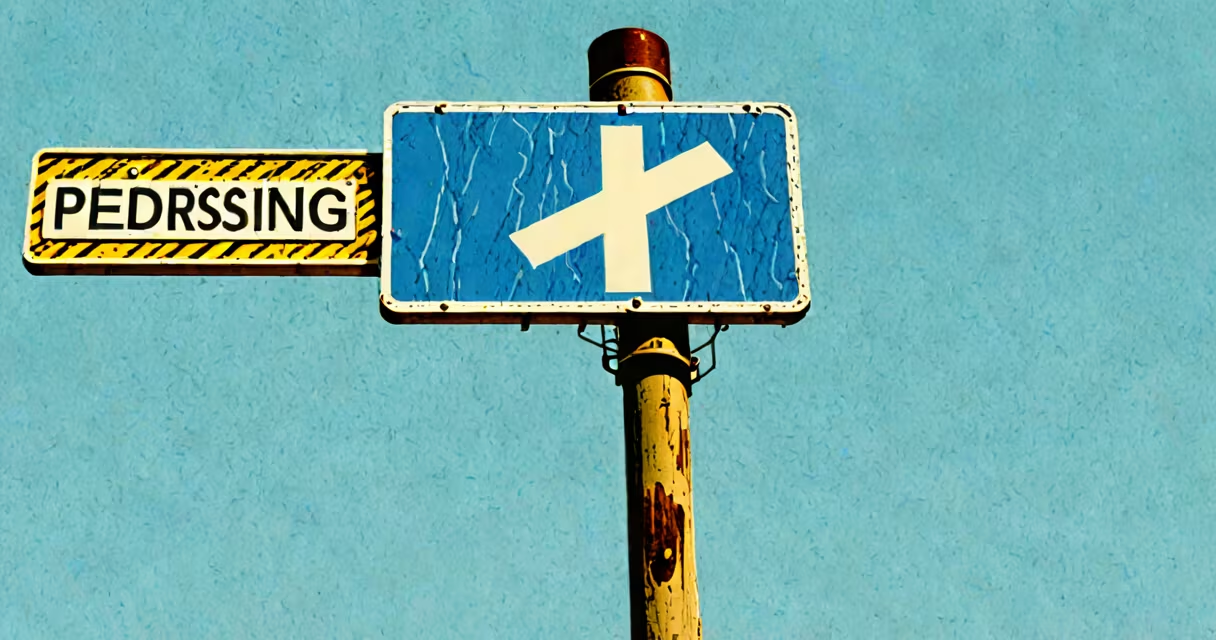
A sign is a visual symbol or written message displayed to communicate information, direct behavior, or warn of potential danger. Signs are engineered for immediate recognition and consistent interpretation across languages and cultures.
Signs operate through standardized shapes, colors, symbols, and typography. A red octagon with black letters always means "stop." A blue circle with a white cross indicates a medical facility. These signals bypass language barriers and reduce response time in high-stakes environments.
The International Organization for Standardization (ISO) publishes guidelines for safety signs, including ISO 7010, which defines over 100 standardized symbols used globally. The U.S. Department of Transportation's Manual on Uniform Traffic Control Devices (MUTCD) governs road signs in federal highways, ensuring uniformity across state lines.
Signs rely on visual perception principles. High contrast between background and text improves legibility. Color psychology plays a role: red signals urgency, green indicates safety, yellow warns of caution. Shapes reinforce meaning-circles often denote prohibitions, triangles indicate warnings, rectangles provide information.
Research from the University of California, Berkeley, shows that people process sign content in under 0.5 seconds when design follows established conventions. This rapid comprehension is critical in emergencies, such as fire evacuation routes or chemical spill warnings.
For example, a hospital emergency room uses a red cross on a white background. This symbol appears on signage, vehicles, and even clothing. Its global recognition allows patients and staff to locate care instantly, regardless of spoken language.
Signs fall into four primary categories based on purpose:
| Type | Purpose | Examples | Design Features |
|---|---|---|---|
| Informational | Provide directions or details | Building nameplate, restroom sign | Blue or green background, clear font |
| Directional | Show location or route | Exit signs, airport terminal maps | Green or white text, arrows, illuminated |
| Warning | Alert to hazards | "Wet Floor" sign, "High Voltage" sticker | Yellow background, black symbol, triangle shape |
| Prohibitory | Stop actions | "No Smoking," "Do Not Enter" | Red circle with diagonal bar, black symbol |
Some signs combine functions. A traffic light is both informational (color-coded signals) and directive (telling drivers when to stop or go). A school zone sign includes a speed limit (informational), a school icon (symbolic), and flashing lights (urgent attention).
Non-standard signs risk misinterpretation. A study by the National Institute of Standards and Technology (NIST) found that custom-designed hazard signs reduced correct identification by 37% compared to standardized ones. Using official symbols ensures clarity and legal compliance.
People often confuse signs with signage. A sign is a single unit-a physical or digital display. Signage refers to the entire system of signs in a space, such as a shopping mall's network of directional and informational signs.
Another mistake is assuming all signs require text. Many international signs use pictograms. The universal symbol for a restroom-two silhouettes, one male, one female-is understood in over 190 countries. Text is not necessary when symbols follow ISO 7010 standards.
Even subtle differences matter. A "No Parking" sign with a red circle and slash applies only to parking. A "No Entry" sign with a red circle and horizontal bar prohibits access entirely. Confusing them can result in fines or accidents.
At Hartsfield-Jackson Atlanta International Airport, signs guide 100 million annual travelers. Each sign follows the FAA's Airports Guide (FAA Order 5100.37), which mandates specific fonts, spacing, and color contrasts.
For instance, the sign "Departures - Level 3" uses a sans-serif font (Helvetica Neue), 1.5 inches tall, on a white background with black text. The word "Departures" is capitalized, and the level number is smaller but aligned. This consistency reduces cognitive load during travel stress.
I once observed a passenger pause at a sign reading "Terminal B - Gates 1-20." They looked left, then right, then back. The sign had no arrow or directional cue. After five seconds, they moved toward Gate 1. That delay cost them 12 minutes of walking time. A simple arrow pointing to the terminal entrance would have cut confusion in half.
This illustrates a key principle: signs don't just inform-they manage movement. Poor design increases congestion, delays, and user frustration. Effective signs anticipate behavior, not just report it.
Signs differ from icons, labels, and symbols. An icon is a simplified image used in digital interfaces (like a trash can for delete). A label identifies an object ("Door A"). A symbol is a generic representation (e.g., a heart for love). A sign integrates these elements into a functional message.
For example, a "No Smoking" sign combines a red circle (prohibition), a cigarette with a slash (symbol), and the word "No" (text). It's not just a picture-it's a command.
Finally, understand the difference between "sign" and "not equals sign." The not equals sign (≠) is a mathematical operator used in equations. It is not a communication tool. It does not convey warnings or directions. See not equals sign for proper usage in math and programming.
Understanding what is a sign begins with recognizing its role as a universal communicator. Whether guiding a traveler through an airport or warning of a chemical hazard, signs deliver meaning instantly and reliably. Their power lies not in complexity, but in clarity.