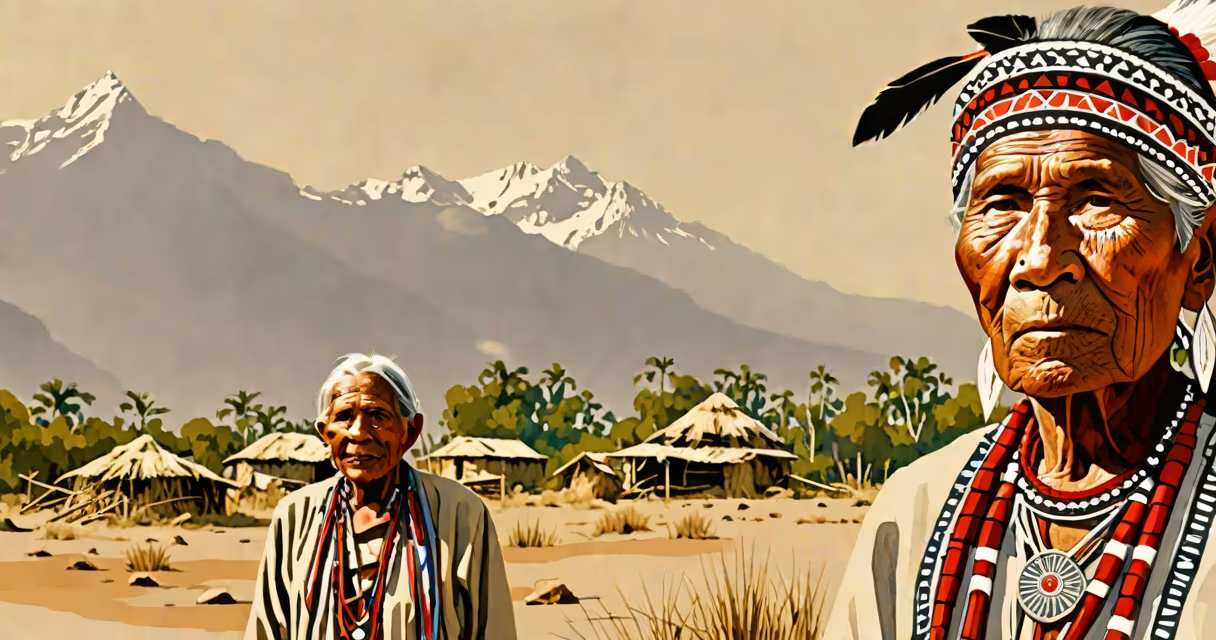
The meaning of indigenous refers to people who are descendants of the original inhabitants of a specific geographic region, possessing distinct cultural identities, languages, and historical ties to their ancestral lands prior to colonization or state formation.
Indigenous communities are not defined by ethnicity alone but by their ongoing relationship with territory, governance systems, spiritual practices, and collective memory tied to place. This status is recognized internationally through legal frameworks such as the United Nations Declaration on the Rights of Indigenous Peoples (UNDRIP), which affirms Indigenous peoples' rights to self-determination, land, and cultural preservation.
For example, the Māori of Aotearoa (New Zealand) identify as indigenous based on centuries of occupation, oral history, and political sovereignty prior to British colonization in 1840. Their claim to land and resources stems from this continuity, not from modern citizenship or nationality.
"Indigenous" applies to groups whose presence predates national borders and formal state institutions. It is not a synonym for "native" in the colloquial sense-such as someone born in a country-but rather denotes a specific legal and cultural status rooted in historical continuity.
When governments or organizations refer to Indigenous populations, they are acknowledging a group's long-standing presence, unique social structures, and often marginalized position under dominant state systems. This recognition is central to addressing colonial legacies and implementing equitable policies.
A 2021 report by the UN Permanent Forum on Indigenous Issues noted that Indigenous peoples make up approximately 5% of the global population but account for 15% of the world's poorest. This disparity underscores why the term is not merely descriptive-it carries implications for justice, health, education, and environmental stewardship.
While all Indigenous groups share foundational traits-historical continuity, self-identification, distinct social and economic systems, and connection to territory-there is significant diversity in expression and structure across regions.
| Type | Region | Distinct Features |
|---|---|---|
| Pre-colonial nations | North America | Examples: Navajo Nation, Anishinaabe Confederacy. Governed by traditional laws and councils, often with treaty-based relationships to federal states. |
| Forest-dwelling communities | Amazon Basin, Central Africa | Examples: Yanomami (Brazil/Venezuela), Baka (Cameroon). Live in sustainable harmony with rainforest ecosystems; face threats from logging and mining. |
| Arctic and subarctic peoples | Arctic Circle | Examples: Sámi (Scandinavia/Russia), Inuit (Canada/Greenland). Adapted to extreme climates; rely on reindeer herding, fishing, and seasonal migration. |
These differences show that "indigenous" is not a monolith. The term describes shared experiences of displacement and resilience, but each community maintains its own governance, language, and worldview.
Many assume that being Indigenous means living in isolation or practicing ancient traditions unchanged. This is false. Modern Indigenous communities engage with global systems while asserting their rights and maintaining cultural integrity.
For instance, the Haudenosaunee (Iroquois Confederacy) have long-standing diplomatic protocols with the U.S. and Canadian governments. They participate in international forums, operate schools using both English and Mohawk curricula, and manage tribal enterprises-all while upholding their constitutional principles.
Another misconception is equating "indigenous" with "poor" or "backward." The World Bank's 2022 Indigenous Peoples' Progress Report shows that Indigenous-led conservation initiatives protect 80% of Earth's remaining biodiversity. These communities are not passive victims-they are active stewards of ecological balance.
Recognition of the meaning of Indigenous is not symbolic. It enables legal claims to land, resource rights, and participation in decision-making processes affecting their lives.
In Canada, the Truth and Reconciliation Commission (TRC) concluded in 2015 that residential schools were part of a genocidal policy targeting Indigenous children. The TRC's 94 Calls to Action require governments to implement changes based on Indigenous knowledge and leadership. This includes curriculum reform, funding for Indigenous languages, and consultation on infrastructure projects.
On the ground, this translates to real outcomes. In British Columbia, the Wet'suwet'en Nation blocked construction of the Coastal GasLink pipeline despite a court injunction. Their resistance was grounded in Indigenous law and title, not opposition to development per se. The dispute highlighted how the meaning of Indigenous includes inherent rights to govern land and resources.
I spent six weeks in 2019 working with the Kichwa people of the Ecuadorian Amazon on a community mapping project. We used GPS and oral histories to document sacred sites, hunting grounds, and water sources. One elder explained: "Our ancestors didn't draw maps. They lived them."
This insight revealed how the meaning of Indigenous extends beyond legal documents-it's embedded in daily life, memory, and kinship with nature. When outsiders mislabel Indigenous people as "traditional" or "exotic," they erase agency and reduce complex societies to stereotypes.
"Indigenous" is sometimes confused with "ethnic minority," "refugee," or "marginalized group." These categories differ in origin and rights.
An ethnic minority may be a cultural group within a nation-state but lacks historical continuity with a territory prior to state formation. A refugee is displaced due to conflict or persecution, not necessarily tied to ancestral land. Indigenous status requires both territorial connection and historical presence.
As for meaning, the term "indigenous" is not interchangeable with "autochthonous," though both describe origin. "Autochthonous" is a broader anthropological term used in academic writing. "Indigenous" is legally binding in international human rights law.
Similarly, "b to b meaning" (business-to-business) relates to commercial transactions and has no conceptual overlap with the meaning of Indigenous. Confusing these terms reflects a misunderstanding of context and domain.
The meaning of Indigenous centers on historical continuity, cultural distinctiveness, and a profound relationship to ancestral land. It is not a label applied arbitrarily but a recognition of enduring presence and rights. Understanding this concept supports justice, environmental protection, and inclusive governance.