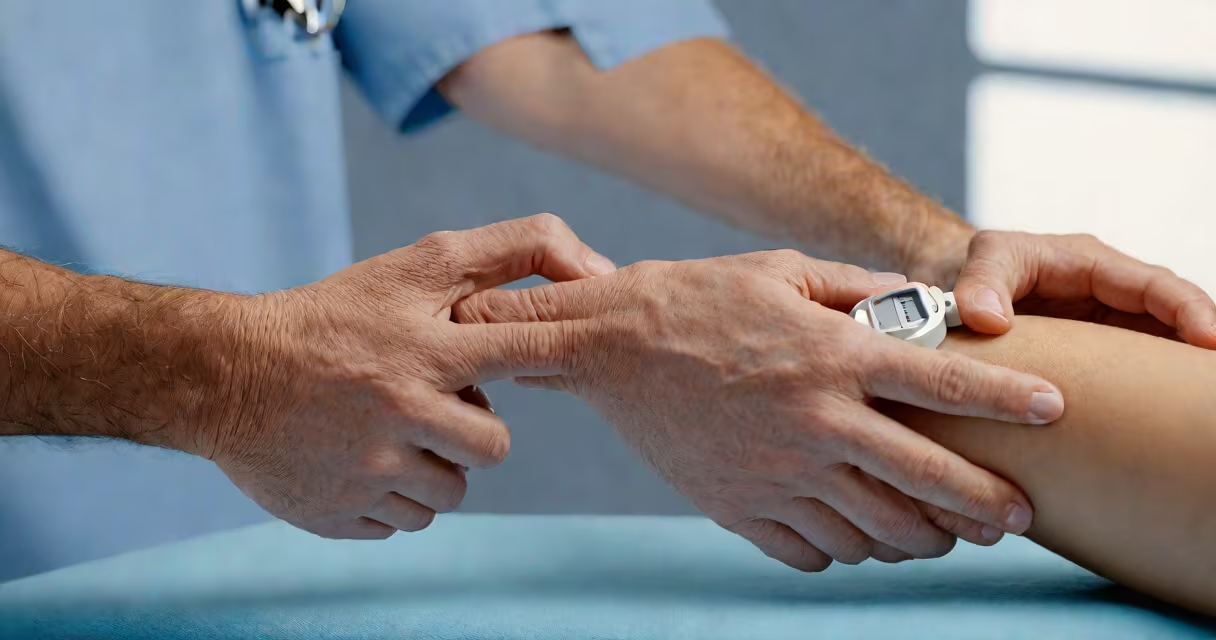
Induration in medical terms describes the abnormal hardening of tissue, typically due to inflammation, infection, or fibrosis. It is a physical finding detected during a clinical examination, most commonly through palpation-feeling the skin or underlying tissue with the fingers.
This hardening occurs when fluid, immune cells, or scar-like tissue accumulate in a localized area. The term is frequently used in dermatology, infectious disease, and rheumatology to describe changes in skin or deeper tissues that feel firm or rock-like under the skin. Induration is not a diagnosis itself but a sign that guides further evaluation.
For example, a 45-year-old patient presents with a red, swollen patch on their forearm that feels stiff and unyielding to touch. The clinician notes induration, which raises suspicion for cellulitis or a localized abscess. Without this physical finding, the diagnosis might be delayed.
Induration results from an accumulation of inflammatory cells-like neutrophils and macrophages-along with increased collagen deposition and fluid leakage into tissues. This process is part of the body's response to injury, infection, or autoimmune activity.
When tissue becomes inflamed, blood vessels dilate and become more permeable. Fluid and immune cells leak into surrounding areas, increasing pressure and density. Over time, fibroblasts lay down collagen fibers, leading to fibrosis-the formation of dense, rigid scar tissue. This is why induration can persist even after the initial cause resolves.
A classic example is the tuberculin skin test (Mantoux test). After injecting purified protein derivative (PPD) into the forearm, a healthcare provider measures the induration (not just redness) at the site 48-72 hours later. A reaction of 10 mm or more of induration indicates a positive result for latent tuberculosis infection.
Induration varies in appearance and significance depending on location and underlying cause. The following table outlines common contexts and associated conditions:
| Type | Common Location | Typical Cause | Example Condition |
|---|---|---|---|
| Skin induration | Extremities, trunk | Infection, allergic reaction | Cellulitis, erysipelas |
| Subcutaneous induration | Lower limbs, buttocks | Autoimmune disorder | Localized scleroderma |
| Deep tissue induration | Internal organs (e.g., lung) | Fibrosis, chronic inflammation | Pulmonary fibrosis, sarcoidosis |
Induration is not always visible. A deep abscess in the abdomen may not show skin changes but can still be felt as a firm mass during a physical exam. This makes palpation essential in detecting internal pathology.
One non-obvious distinction: induration is not the same as edema. Edema refers to swelling caused by excess fluid in tissues and feels soft or pitting (indentation remains after pressing). Induration feels firm and non-pitting. Confusing the two leads to misdiagnosis-especially in patients with heart failure or kidney disease, where both can coexist.
Induration is a key component of the physical examination. It helps clinicians differentiate between acute and chronic processes, localize pathology, and decide whether imaging or biopsy is needed.
For instance, in diagnosing syphilis, a primary chancre often presents as a painless, indurated ulcer on the genitals. The hardness distinguishes it from other genital lesions, such as those caused by herpes simplex virus, which tend to be softer and vesicular.
During a breast exam, a lump that feels hard and fixed to surrounding tissue may indicate invasive ductal carcinoma. The presence of induration increases the likelihood of malignancy, prompting a mammogram or ultrasound.
As a clinician, I once evaluated a patient with a persistent neck mass. Initial ultrasound showed a solid lesion, but the key clue was induration-on palpation, the mass felt like a rock. Biopsy confirmed metastatic squamous cell carcinoma from an undiagnosed oral lesion. Without recognizing induration, the diagnosis could have been delayed.
Many assume induration means cancer. That's incorrect. While induration can signal malignancy, it's far more common in benign conditions like chronic infections or autoimmune diseases.
Another misconception: induration is always painful. It is not. A patient with advanced sarcoidosis may have induration in the lungs or lymph nodes without symptoms. The finding is incidental on imaging or during routine exams.
Also, induration is not synonymous with "hardness" in everyday language. In medicine, it specifically refers to pathological firmness resulting from cellular infiltration or fibrosis-not simply muscle tension or fat deposits.
According to the American Academy of Dermatology, induration is a critical sign in diagnosing cutaneous lupus erythematosus. Lesions that are indurated and scaly are more likely to lead to scarring than those that are erythematous only.
The World Health Organization notes that in TB screening programs, accurate measurement of induration in the Mantoux test reduces false-negative rates by 15% compared to relying solely on redness.
Understanding induration requires distinguishing it from similar terms:
These differences matter. Mislabeling a pitting edema as induration leads to unnecessary biopsies. Mistaking a fibrotic mass for a malignant tumor can cause anxiety and overtreatment.
Induration meaning medical is a precise clinical descriptor rooted in physical examination. It signals tissue changes that require investigation but is not diagnostic on its own. Accurate recognition improves early detection of serious conditions-from infections to cancer-and supports better patient outcomes.